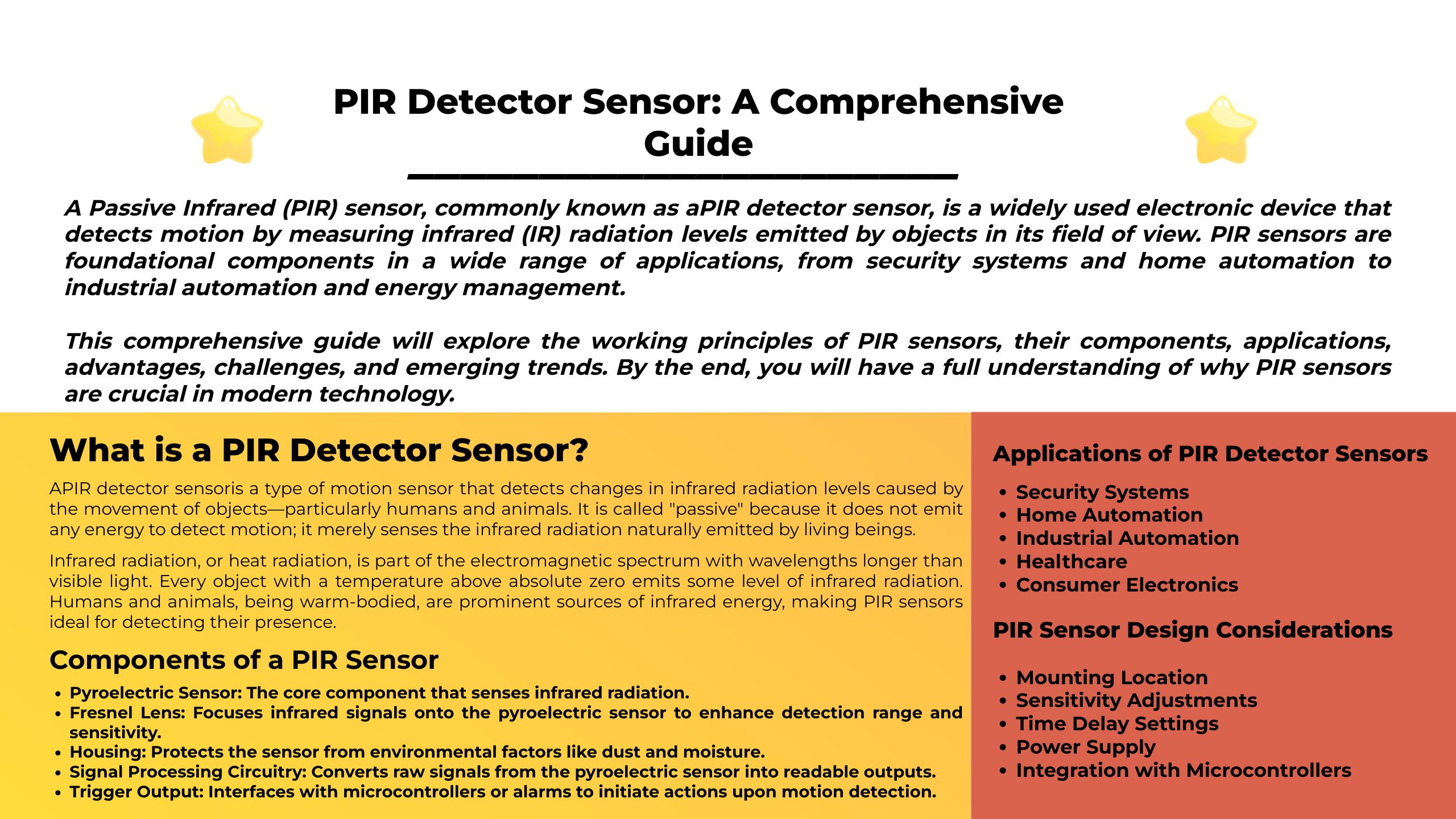
A Passive Infrared (PIR) sensor, commonly known as a PIR detector sensor, is a widely used electronic device that detects motion by measuring infrared (IR) radiation levels emitted by objects in its field of view. PIR sensors are foundational components in a wide range of applications, from security systems and home automation to industrial automation and energy management.
This comprehensive guide will explore the working principles of PIR sensors, their components, applications, advantages, challenges, and emerging trends. By the end, you will have a full understanding of why PIR sensors are crucial in modern technology.
1. What is a PIR Detector Sensor?
A PIR detector sensor is a type of motion sensor that detects changes in infrared radiation levels caused by the movement of objects—particularly humans and animals. It is called “passive” because it does not emit any energy to detect motion; it merely senses the infrared radiation naturally emitted by living beings.
More About PIR: What is PIR: A Comprehensive Guide to Passive Infrared Sensors
Infrared radiation, or heat radiation, is part of the electromagnetic spectrum with wavelengths longer than visible light. Every object with a temperature above absolute zero emits some level of infrared radiation. Humans and animals, being warm-bodied, are prominent sources of infrared energy, making PIR sensors ideal for detecting their presence.
2. How a PIR Detector Sensor Works
PIR sensors are designed to detect a change in infrared radiation in their environment. Here’s a step-by-step explanation of the process:
2.1 Components of a PIR Sensor
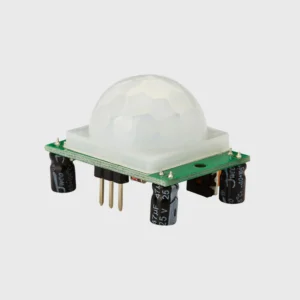
A typical PIR sensor includes:
- Pyroelectric Sensor: The core component that senses infrared radiation.
- Fresnel Lens: Focuses infrared signals onto the pyroelectric sensor to enhance detection range and sensitivity.
- Housing: Protects the sensor from environmental factors like dust and moisture.
- Signal Processing Circuitry: Converts raw signals from the pyroelectric sensor into readable outputs.
- Trigger Output: Interfaces with microcontrollers or alarms to initiate actions upon motion detection.
2.2 Detection Mechanism
- Baseline Monitoring: The PIR sensor continuously monitors the baseline levels of infrared radiation.
- Motion Detection: When a warm body (e.g., a human) moves across the field of view, it causes a rapid change in infrared radiation levels.
- Signal Generation: The pyroelectric element detects this change and generates a small electrical signal.
- Processing: The circuit amplifies and processes the signal to determine whether it matches the profile of a valid motion event.
- Action: The sensor triggers an output, such as activating a light, sounding an alarm, or sending a signal to a controller.
3. Characteristics of PIR Sensors
- Low Power Consumption: Ideal for battery-operated devices.
- Wide Field of View: Can detect motion over a large area.
- Cost-Effective: Affordable and easy to manufacture.
- Selective Sensitivity: Designed to ignore small animals or environmental changes, reducing false alarms.
- Instantaneous Response: Detects motion as soon as it occurs.
These features make PIR sensors incredibly versatile for many applications.
4. Typical Specifications of PIR Sensors
- Detection Range: 5–20 meters (varies based on model)
- Field of View: 90–180 degrees horizontally
- Operating Voltage: 3V to 12V DC (common)
- Trigger Time: 0.5–5 seconds (configurable)
- Delay Time: Adjustable in some models
- Ambient Light Immunity: Typically immune to visible light changes
Understanding these specifications is vital for choosing the right PIR sensor for your application.
5. Applications of PIR Detector Sensors
PIR sensors are used in a diverse range of applications:
5.1 Security Systems
- Intrusion detection
- Automatic door opening
- Surveillance camera activation
5.2 Home Automation
- Automatic lighting control
- HVAC optimization
- Smart home occupancy detection
5.3 Industrial Automation
- Energy-efficient lighting in warehouses
- Machinery control based on operator presence
5.4 Healthcare
- Patient movement monitoring
- Elderly care fall detection systems
5.5 Consumer Electronics
- Motion-controlled gaming devices
- Smart TVs that power down when no one is present
The adaptability of PIR sensors makes them integral to countless modern conveniences and safety features.
6. PIR Sensor Design Considerations
When designing a system that incorporates PIR sensors, several factors must be considered:
6.1 Mounting Location
- Avoid direct sunlight or reflective surfaces that could generate false positives.
- Position sensors to maximize coverage of entry points or areas of interest.
6.2 Sensitivity Adjustments
- Fine-tune the sensor to detect humans while ignoring small pets.
- Some sensors come with adjustable sensitivity settings.
6.3 Time Delay Settings
- Configure the amount of time the sensor’s output stays active after detecting motion.
- Useful for applications like keeping lights on for a preset period.
6.4 Power Supply
- Choose sensors compatible with the available voltage range.
- Battery-powered PIRs need energy-efficient designs.
6.5 Integration with Microcontrollers
- PIR outputs can often directly interface with Arduino, Raspberry Pi, and other platforms.
- Libraries and codes are widely available for easy integration.
7. Advantages of PIR Sensors
- Non-intrusive: They detect motion without invading privacy, unlike cameras.
- Reliable: Proven track record in a variety of environments.
- Affordable: Mass production keeps costs low.
- Simple to Interface: Easy integration into larger systems.
- Energy Saving: Helps reduce unnecessary lighting or HVAC operation.
These advantages explain why PIR sensors dominate the motion detection landscape.
8. Challenges and Limitations
Despite their benefits, PIR sensors do have some limitations:
- Limited Range: They are best suited for small to medium-sized areas.
- Blind Spots: Due to lens design, coverage may not be perfectly uniform.
- Temperature Sensitivity: High ambient temperatures can reduce contrast between the background and the moving object, diminishing effectiveness.
- Stationary Objects: PIR sensors detect motion, not presence. A stationary person may go undetected after initial detection.
- False Positives: Rapid temperature changes from HVAC vents or sunlight reflections can sometimes trigger false alarms.
Recognizing these challenges is crucial for designing robust motion detection systems.
9. PIR Sensors vs Other Motion Sensors
There are various types of motion detectors besides PIR:
| Feature | PIR Sensors | Microwave Sensors | Ultrasonic Sensors | Camera-based Sensors |
|---|---|---|---|---|
| Detection Principle | Infrared Radiation | Doppler Effect | Sound Waves | Visual Motion |
| Cost | Low | Medium | Medium | High |
| Power Consumption | Very Low | Moderate | Moderate | High |
| Penetrates Obstacles | No | Yes | Yes | No |
| Sensitivity to Small Movements | Low | High | High | Very High |
| Privacy Concern | None | None | None | High |
In some systems, designers combine PIR with other technologies to leverage the strengths of each.
10. Future Trends in PIR Sensor Technology
Technological advancements are enhancing PIR sensor capabilities:
10.1 Digital PIR Sensors
Digital processing improves signal clarity, reduces noise, and enables more intelligent event recognition.
10.2 AI-Enhanced Detection
Artificial intelligence can analyze PIR data to distinguish between humans, animals, and environmental noise more accurately.
10.3 Miniaturization
Smaller sensors allow for integration into compact IoT devices, wearables, and smart gadgets.
10.4 Integration with Smart Home Platforms
PIR sensors are becoming increasingly compatible with systems like Alexa, Google Home, and Apple HomeKit.
10.5 Energy Harvesting PIR Sensors
Future PIR sensors may power themselves through ambient energy sources, eliminating the need for batteries.
These innovations promise to extend PIR sensors’ already wide-ranging applications even further.
11. Case Studies
11.1 Smart Lighting Systems
Offices equipped with PIR-based lighting systems have seen energy savings of up to 40%, as lights are only on when necessary.
11.2 Home Security
DIY security systems often rely on PIR sensors for indoor monitoring, allowing users to create customized, affordable safety solutions.
11.3 Public Restroom Management
Some smart restroom systems use PIR sensors to optimize lighting, ventilation, and cleaning schedules based on real occupancy patterns.
Conclusion
The PIR detector sensor is an indispensable technology that has transformed how we detect motion in homes, industries, healthcare, and security. With its simple yet effective operating principle, affordability, and low power consumption, the PIR sensor continues to be a top choice for motion detection systems worldwide.
While there are some challenges, ongoing advancements in digital processing, AI integration, and miniaturization promise a bright future for PIR technology. As smart environments become increasingly common, the role of PIR sensors will only grow more significant, enhancing our lives in ways both seen and unseen.