
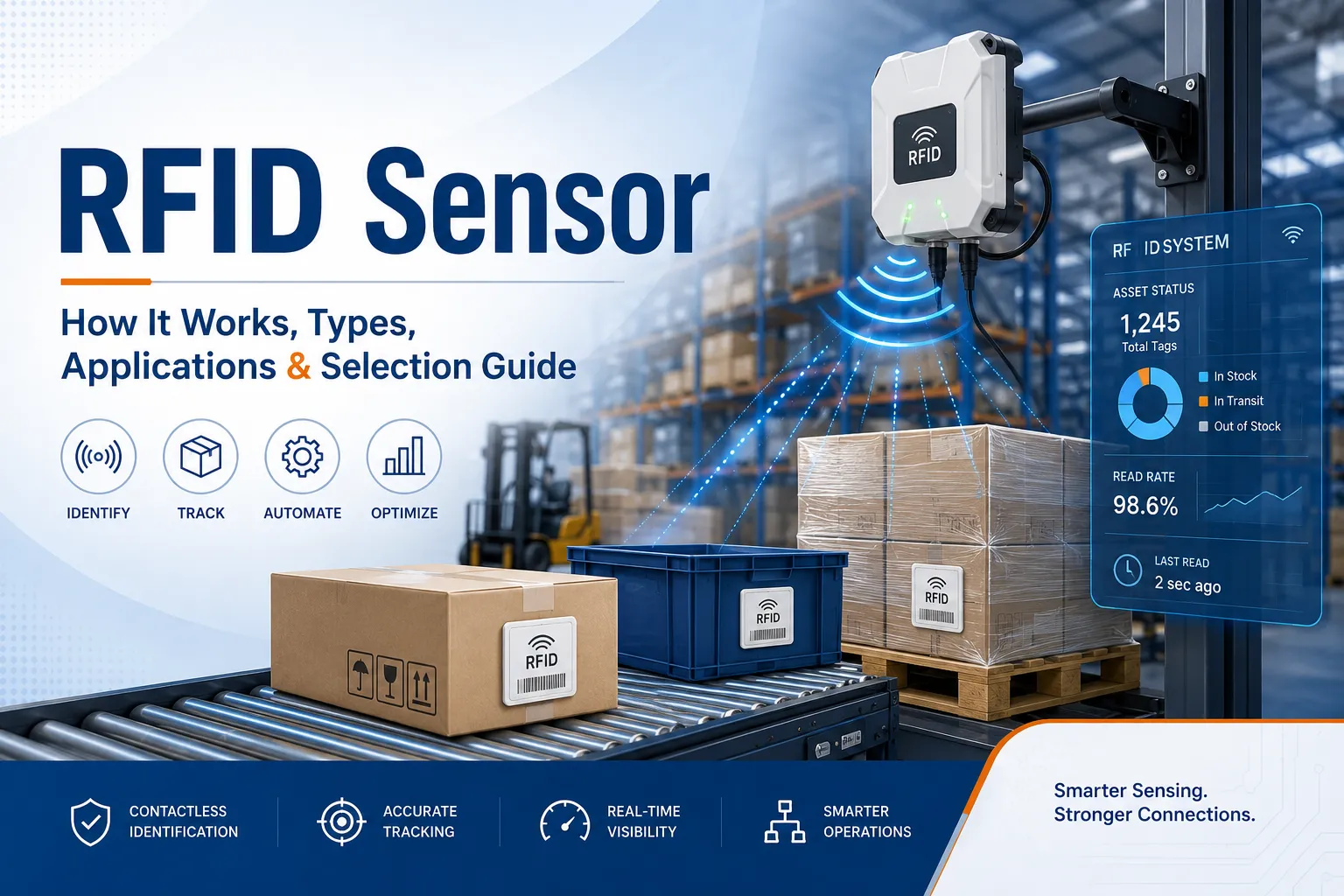
RFID sensors combine wireless identification with automated data collection, allowing businesses to identify, track and manage objects without manually scanning every item.
They are widely used in warehouses, manufacturing facilities, hospitals, retail stores, libraries, transportation systems and industrial asset-management projects. Compared with conventional barcodes, an RFID system does not always require direct line of sight and can read multiple tagged objects within the same reading zone.
However, the term “RFID sensor” can have more than one meaning. It may refer to an RFID reader that detects nearby tags, or to an RFID tag equipped with a sensing element that measures temperature, humidity, pressure, motion or other environmental conditions.
Understanding this distinction is important when selecting RFID equipment for a new project.
What Is an RFID Sensor?
An RFID sensor is a wireless device or system that uses radio-frequency identification technology to detect, identify or monitor tagged objects.
A standard RFID system normally includes:
- RFID tags attached to the objects
- An RFID reader or interrogator
- One or more RFID antennas
- Communication interfaces
- Middleware or management software
- A database, ERP, WMS or other business platform
The reader sends a radio-frequency signal through the antenna. When a compatible tag enters the reading field, it responds with stored information such as a unique identification number.
The software then associates that identification number with a specific product, pallet, tool, document, vehicle, employee badge or piece of equipment.
RFID Reader vs RFID Sensor Tag
Although the terms are sometimes used interchangeably, an RFID reader and an RFID sensor tag perform different functions.
RFID Reader
An RFID reader communicates with nearby RFID tags. Depending on the application, it may be:
- A fixed RFID reader
- An integrated RFID reader
- A desktop reader
- A handheld terminal
- A gate reader
- An embedded RFID module
The reader collects tag information and transfers it to the connected software system.
RFID Sensor Tag
An RFID sensor tag contains an RFID chip, antenna and one or more sensing elements.
In addition to transmitting identification data, it may collect information such as:
- Temperature
- Humidity
- Pressure
- Vibration
- Shock
- Strain
- Moisture
- Light exposure
- Gas concentration
- Open or closed status
For example, an RFID temperature sensor tag can identify a pharmaceutical package while also recording whether it has been exposed to temperatures outside the permitted range.
How Does an RFID Sensor Work?
A typical RFID sensing process includes five stages.
1. The Reader Generates a Radio Signal
The RFID reader generates a radio-frequency signal and sends it to an antenna.
2. The Antenna Creates a Reading Field
The antenna converts the electrical signal into radio waves and creates a defined RFID reading zone.
3. The RFID Tag Enters the Field
When a compatible tag enters the reading zone, it receives the reader signal.
Passive tags obtain operating energy from the reader’s radio-frequency field. Active tags use their own internal batteries.
4. The Tag Transmits Its Data
The tag responds with information stored in its memory. Depending on the tag, this may include:
- Electronic Product Code
- Tag identification number
- Product data
- Batch information
- Maintenance records
- Sensor measurements
5. The Software Processes the Information
The reader transfers the collected information to a computer, server, cloud platform or industrial controller.
The software can then update inventory records, trigger an alarm, open a gate, record a production step or send information to an ERP or warehouse-management system.
Main Types of RFID Sensors
RFID sensors can be classified by power source, frequency band, reader configuration and sensing capability.
Passive RFID Sensors
Passive RFID tags do not contain an internal battery. They receive energy from the RFID reader’s electromagnetic field.
Their main advantages include:
- Compact construction
- Low unit cost
- Long operating life
- Minimal maintenance
- Availability in many shapes and materials
- Suitability for large-scale deployment
Passive RFID is commonly used for:
- Retail inventory
- Warehouse management
- Product identification
- Tool tracking
- Document management
- Library systems
- Laundry and textile tracking
- Access cards
The actual reading distance depends on the frequency, reader output, antenna design, tag construction, installation environment and tagged material.
Active RFID Sensors
Active RFID tags contain their own battery and can transmit signals over a greater distance.
They are often selected for:
- Vehicle tracking
- Large equipment monitoring
- Container management
- Construction sites
- Mining operations
- Personnel location
- Real-time location systems
- High-value asset tracking
Active RFID tags generally provide longer communication distances and more frequent data transmission, but they are larger and more expensive than passive tags.
Their batteries also have a limited service life.
Battery-Assisted Passive RFID Sensors
Battery-assisted passive, or semi-passive, RFID tags contain a battery that powers the internal chip or sensing element.
Unlike a fully active tag, communication may still depend on receiving an interrogation signal from the RFID reader.
This design is useful when an application requires:
- Improved sensing performance
- Periodic environmental measurements
- Longer reading distance than standard passive tags
- Lower power consumption than active systems
Battery-assisted RFID sensor tags are frequently considered for cold-chain, pharmaceutical and environmental-monitoring applications.
Chipless RFID Sensors
Chipless RFID sensors do not use a conventional integrated circuit. Instead, the tag structure changes its electromagnetic response according to the measured condition.
Potential applications include:
- Moisture detection
- Structural monitoring
- Temperature indication
- Food packaging
- Low-cost disposable sensing
Chipless RFID remains more specialized than conventional chip-based RFID and may require application-specific readers and signal-processing methods.
RFID Frequency Bands
The operating frequency affects reading distance, data rate, tag size, environmental performance and regional compliance.
Low-Frequency RFID
Low-frequency RFID is commonly used for short-distance identification.
Typical applications include:
- Animal identification
- Vehicle immobilizers
- Access control
- Industrial identification
LF systems generally perform relatively well around water and some challenging materials, but they normally provide shorter reading distances and lower data speeds.
High-Frequency RFID
High-frequency RFID includes systems commonly operating at 13.56 MHz.
Typical applications include:
- Smart cards
- Library management
- Ticketing
- Product authentication
- Near-field communication
- Access control
HF RFID provides controlled short-range communication and is suitable for applications that require deliberate user interaction.
Ultra-High-Frequency RFID
UHF RFID is widely used in logistics, retail, manufacturing and warehouse automation.
Its advantages include:
- Longer reading distance
- Fast tag identification
- High reading throughput
- Support for multiple tags
- Availability of low-cost passive labels
UHF RFID performance can be affected by metal, liquids, tag orientation and interference. Antennas and tags must therefore be selected and positioned according to the actual installation environment.
Common RFID Sensor Applications
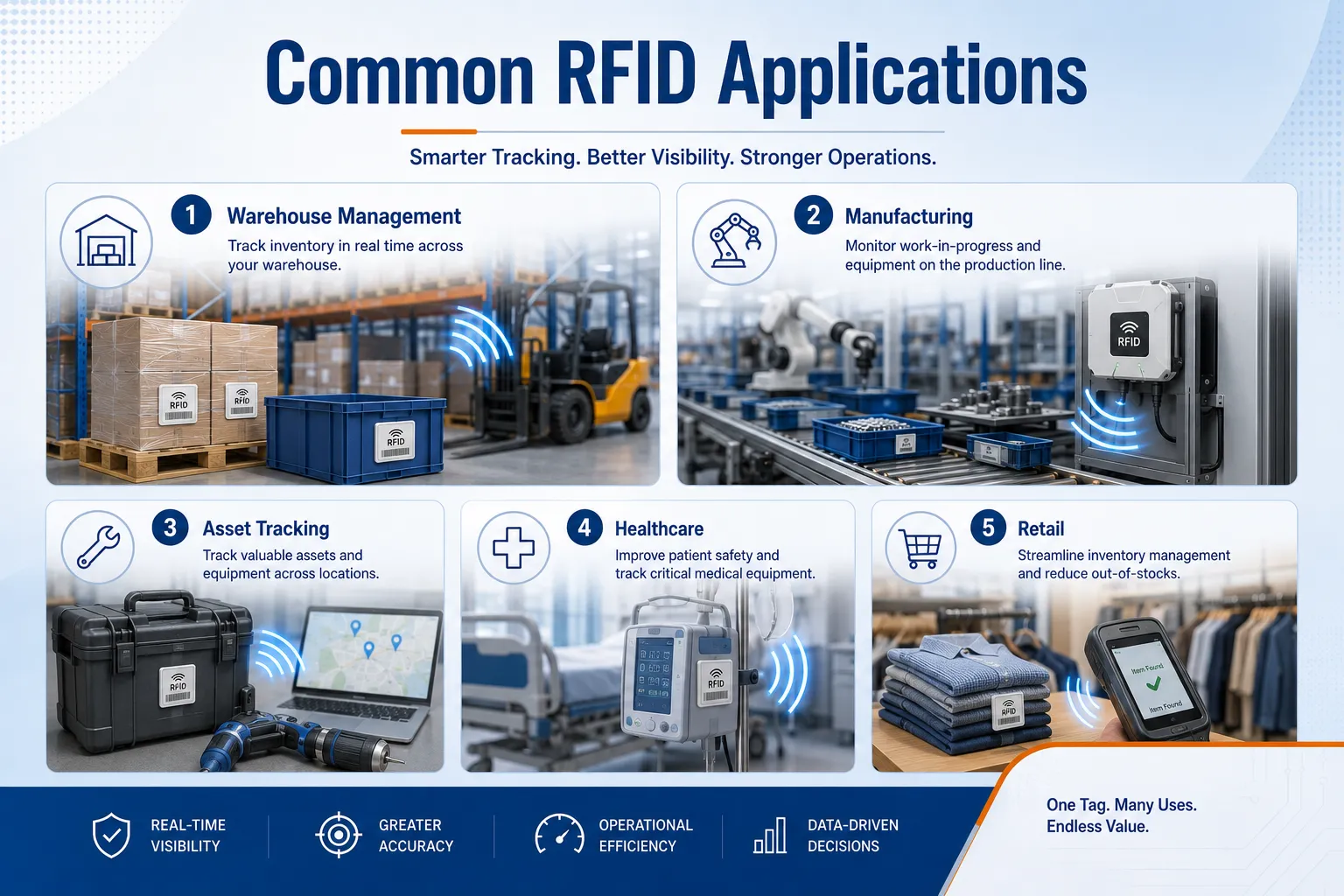
Inventory Management
RFID sensors can automatically identify tagged products, cartons and pallets as they move through warehouses or distribution centers.
The system can support:
- Receiving verification
- Inventory counting
- Put-away confirmation
- Picking verification
- Shipment checking
- Cycle counting
- Stock-location management
Because multiple tags can be detected in one reading zone, RFID can reduce the amount of manual scanning required in high-volume operations.
Industrial Asset Tracking
Companies can attach RFID tags to tools, instruments, molds, test equipment and other valuable assets.
RFID readers placed at storage rooms, production entrances or workshop exits can record when an asset enters or leaves a controlled area.
This helps organizations:
- Locate equipment more quickly
- Reduce loss
- Improve tool availability
- Record asset utilization
- Support calibration management
- Improve maintenance planning
Manufacturing and Work-in-Progress Tracking
RFID sensors can identify components, carriers and workpieces at different production stations.
The collected data can be used to:
- Verify the correct material
- Record production steps
- Prevent assembly errors
- Track work-in-progress
- Associate products with inspection results
- Improve production traceability
RFID is especially useful when barcodes are easily damaged, contaminated or hidden during production.
Cold-Chain Monitoring
RFID sensor tags can combine product identification with temperature or humidity monitoring.
Applications include:
- Vaccines
- Medicines
- Biological samples
- Fresh food
- Frozen products
- Chemicals
- Temperature-sensitive electronics
The system can connect each environmental record to a specific shipment, container or package.
However, an RFID sensor system should not automatically be treated as a replacement for a certified data logger. The required accuracy, calibration, sampling interval and regulatory documentation must be evaluated for each application.
Healthcare and Laboratory Management
Hospitals and laboratories use RFID for:
- Medical equipment tracking
- Sample identification
- Medicine management
- Patient identification
- Surgical instrument tracking
- Blood-product traceability
- Linen management
RFID can reduce time spent searching for equipment and improve visibility across complex healthcare workflows.
Retail and Apparel
Retailers can attach UHF RFID labels to individual products and garments.
RFID supports:
- Rapid inventory counting
- Item-level stock visibility
- Replenishment
- Order fulfillment
- Self-checkout
- Return verification
- Loss-prevention analysis
RFID can be particularly valuable for businesses operating both physical stores and online sales channels because accurate inventory data supports omnichannel fulfillment.
Access Control and Personnel Identification
RFID cards, key fobs, wristbands and badges can be used to identify authorized personnel.
Common applications include:
- Office access
- Factory entrances
- Hotel rooms
- Events
- Campus management
- Parking systems
- Membership systems
Sensitive access-control projects should combine RFID identification with suitable encryption, authentication, permission management and audit records.
Laundry and Textile Tracking
Washable RFID tags can be integrated into uniforms, hotel linen, hospital textiles and industrial garments.
The system can record:
- Textile ownership
- Washing cycles
- Distribution
- Collection
- Sorting
- Replacement
- Loss
The selected tag must tolerate the expected washing temperature, chemicals, pressure, drying process and mechanical stress.
RFID Sensor Advantages
No Direct Line of Sight Required
RFID tags may be detected without placing a printed code directly in front of a scanner.
Multiple Tags Can Be Read
A properly designed RFID system can identify multiple tags within a reading zone.
Automated Data Collection
Fixed readers can collect data as objects pass through doors, conveyor points, production stations or warehouse gates.
Unique Item Identification
Individual items can carry unique electronic identifiers, even when the products appear physically identical.
Rewritable Memory
Some RFID tags allow authorized systems to update selected memory fields.
Flexible Tag Designs
RFID tags are available as:
- Adhesive labels
- Hard tags
- Cards
- Key fobs
- Wristbands
- Laundry tags
- Cable-tie tags
- On-metal tags
- High-temperature tags
- Embedded tags
RFID Sensor Limitations
RFID is not automatically suitable for every tracking project.
Metal and Liquid Interference
Metal surfaces can reflect radio waves, while liquids can absorb RF energy. These effects are especially important in UHF RFID systems.
On-metal tags, spacers, specialized antennas and installation testing may be required.
Unwanted Tag Reads
A reader may detect tags outside the intended area when the reading zone is not properly controlled.
Reader power, antenna direction, shielding and software filters must be configured carefully.
Tag Orientation
The angle between the reader antenna and tag antenna can affect read performance.
Circularly polarized antennas may help when tag orientation is unpredictable, although application testing is still necessary.
System Integration
RFID data must be connected to business processes. A reader installation alone does not create a complete inventory or asset-management solution.
Middleware and software must handle:
- Duplicate reads
- Filtering
- Event logic
- Data validation
- Device management
- Database integration
- Exception handling
Privacy and Security
RFID systems may process information related to products, employees, customers or access permissions.
Projects should consider:
- Data encryption
- Authentication
- Tag memory protection
- Access control
- Network security
- Data-retention policies
- Relevant privacy requirements
RFID Sensor vs Barcode
| Feature | RFID Sensor | Barcode |
|---|---|---|
| Reading method | Radio-frequency communication | Optical scanning |
| Line of sight | Usually not required | Required |
| Multiple-item reading | Supported in many systems | Usually one code at a time |
| Read distance | Depends on RFID type and configuration | Usually short |
| Tag cost | Generally higher | Generally lower |
| Printed visibility | Not required | Printed code must remain readable |
| Memory | May contain writable fields | Normally fixed printed data |
| Metal and liquid sensitivity | Can affect performance | Usually less affected |
| System complexity | Higher | Lower |
RFID and barcode technologies do not always need to compete. Many projects use both.
For example, an RFID label may also include a printed barcode so that employees can scan the item manually when RFID equipment is unavailable.
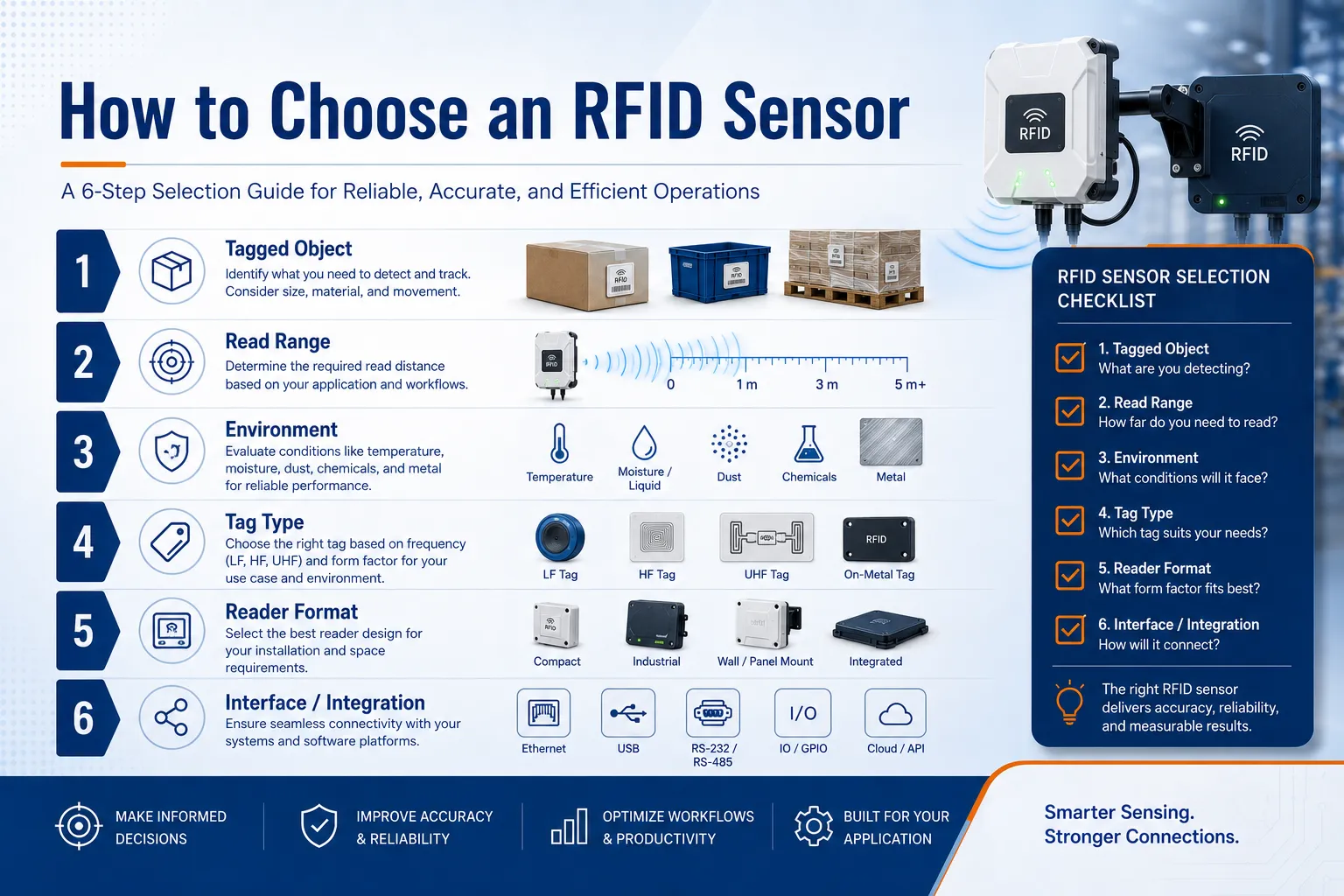
How to Choose an RFID Sensor
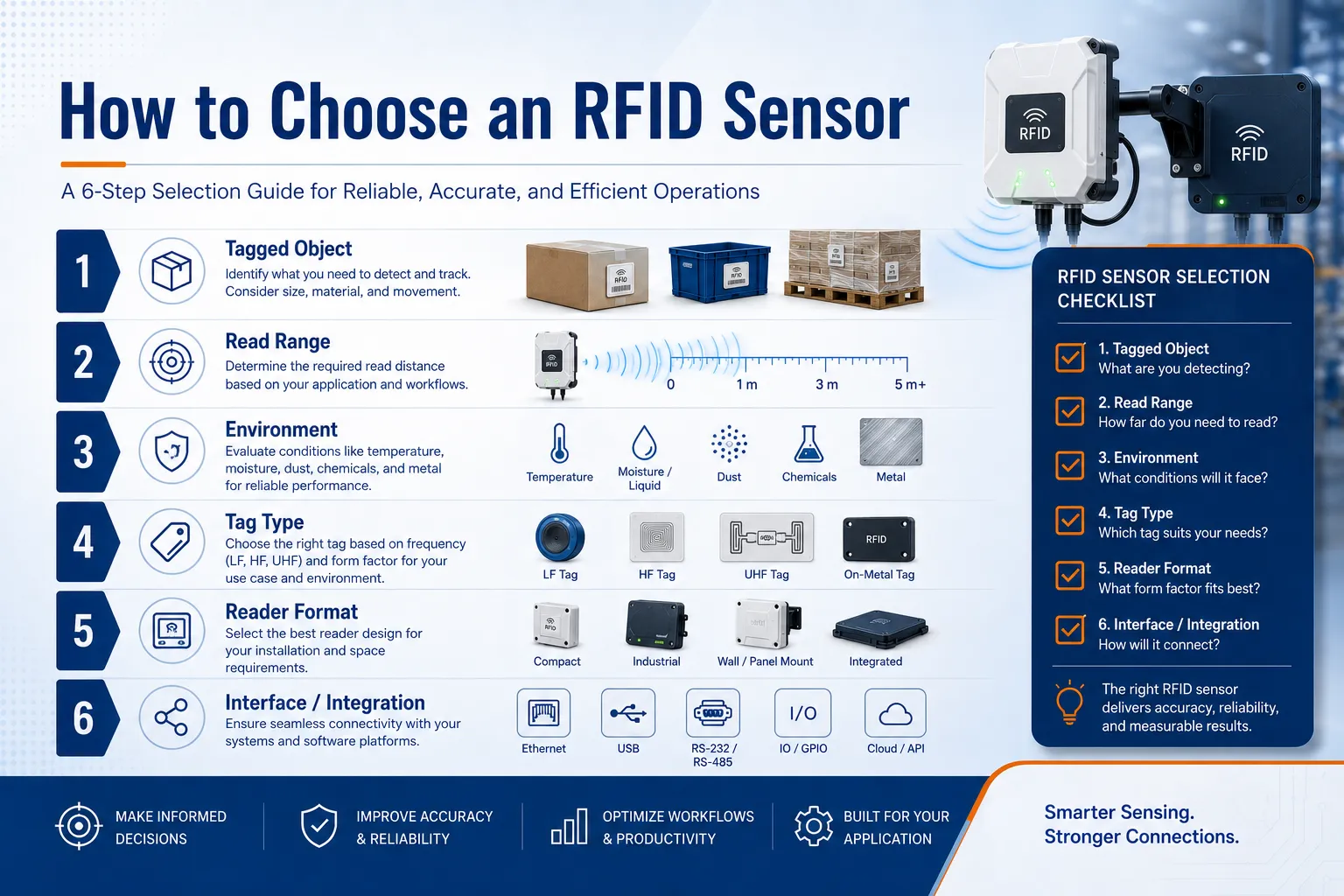
Before purchasing RFID hardware, define the project conditions clearly.
1. Identify the Object
Determine what will be tagged:
- Individual products
- Cartons
- Pallets
- Tools
- Documents
- Vehicles
- People
- Animals
- Metal equipment
- Liquid containers
The tagged material directly influences tag selection.
2. Define the Required Reading Distance
A desktop encoding station may require only a short reading distance, while a warehouse gate or vehicle-management project may require a much larger controlled reading zone.
Longer reading distance is not always better. Excessive range may produce unwanted reads.
3. Determine the Tag Quantity
Estimate how many tags may be present in the reading zone at one time.
High-density applications require suitable reader performance, antenna placement and software filtering.
4. Evaluate the Environment
Consider:
- Indoor or outdoor installation
- Dust
- Water
- Chemicals
- Vibration
- Impact
- Extreme temperatures
- Metal structures
- Nearby wireless equipment
Industrial applications may require rugged enclosures, specialized tags and protected cable connections.
5. Select the Reader Format
Choose between:
- Embedded RFID module
- Desktop reader
- Integrated reader
- Fixed multi-port reader
- Handheld reader
- Access gate
- Intelligent RFID device
For projects requiring readers, modules, handheld terminals, antennas or UHF tags, the available RFID hardware solutions from Syncotek can provide a useful starting point for comparing different device formats. Syncotek’s RFID category includes UHF modules, integrated readers, fixed readers, desktop readers, access gates, handheld devices, antennas and RFID tags.
6. Confirm Communication Interfaces
Common interfaces include:
- USB
- RS232
- RS485
- Ethernet
- Wi-Fi
- Bluetooth
- Wiegand
- GPIO
- CAN
- UART
The selected interface must be compatible with the control system, computer, access controller or industrial network.
7. Check Regional Frequency Requirements
UHF RFID frequency allocations and permitted transmission power differ by country or region.
Hardware must support the regulations of the installation location. Do not select a reader only according to its maximum advertised distance.
8. Conduct an On-Site Test
RFID performance depends on the complete environment.
A proper test should use:
- The actual tagged objects
- The intended tags
- The planned reader
- The planned antennas
- Realistic object speed
- Realistic tag quantity
- The final installation location
Testing several tag models is often more reliable than selecting a tag only from a specification sheet.
Frequently Asked Questions
Is an RFID Reader a Sensor?
An RFID reader can be considered a type of sensing or detection device because it detects and communicates with RFID tags.
However, it does not necessarily measure environmental variables. A true RFID sensor tag includes an additional sensing element for temperature, humidity, pressure or another physical condition.
Can RFID Sensors Work Without Batteries?
Passive RFID tags work without internal batteries. They receive operating energy from the reader’s radio-frequency field.
Active and battery-assisted RFID sensors use batteries to support longer range, repeated measurements or autonomous data collection.
Can RFID Sensors Read Through Walls?
RFID signals may pass through certain non-metallic materials, but performance depends on the frequency, wall material, reader power, antenna design and surrounding environment.
RFID should not be assumed to operate reliably through walls without testing.
Can RFID Sensors Be Used on Metal?
Yes, but standard RFID labels often perform poorly when attached directly to metal.
On-metal RFID tags include structures that isolate or tune the antenna for operation on metallic surfaces.
How Far Can an RFID Sensor Read?
There is no single reading distance for all RFID systems.
Read range depends on:
- Frequency
- Passive or active operation
- Reader output
- Antenna gain
- Tag sensitivity
- Tag orientation
- Installation environment
- Local regulations
The practical reading distance should be verified in the final application.
Can RFID Sensors Measure Temperature?
Yes. RFID temperature sensor tags combine an RFID interface with a temperature-sensing element.
Depending on the design, the tag may transmit a current reading, store historical measurements or provide a threshold indication.
Is RFID Better Than a Barcode?
RFID is useful when a project requires automatic identification, multiple-tag reading, non-line-of-sight operation or more durable identification.
Barcodes remain suitable when low cost, visual identification and simple one-at-a-time scanning are the main requirements.
Conclusion
RFID sensors provide a flexible way to connect physical objects with digital management systems.
A basic RFID system can automatically identify products and assets, while advanced RFID sensor tags can also monitor environmental conditions such as temperature, humidity, vibration or pressure.
Successful deployment depends on more than selecting a reader with the longest advertised range. Businesses must evaluate the tag material, frequency, object movement, reading zone, antenna placement, communication interface, software integration and regional regulations.
By testing the complete system under real operating conditions, organizations can build an RFID solution that improves traceability, inventory visibility, asset utilization and process automation.
Can Another Gas Trigger a Refrigerant Detector? Reading Cross-Sensitivity Claims
Understand refrigerant-detector cross-sensitivity, compare NDIR and MOS evidence, and read gas-interference claims without dismissing a real alarm.
Read More
What Should a Refrigeration Plant-Room Gas Monitoring Log Record?
Build a useful plant-room gas log by recording detector identity, configuration, alarms, faults, ventilation response and maintenance evidence.
Read More
When Does Condensation Mislead an HVAC Sensor?
Learn when condensation at HVAC coils, probes and enclosures changes a sensor reading, and how to distinguish expected drainage from unwanted wetting.
Read More
Portable vs Fixed Refrigerant Detection: How Their Jobs Differ
Compare handheld leak locators, fixed-point monitors and aspirating systems by sample location, response chain and commissioning needs.
Read More
Refrigerant Identification vs Concentration Measurement: Which Test Do You Need?
Distinguish a sealed-charge identifier from ambient concentration monitoring, handheld leak location and formal refrigerant purity testing.
Read More
How Humidity Affects Optical PM2.5 Sensor Readings
Learn why humidity, water uptake, fog and condensation can affect optical PM2.5 estimates and how to investigate and validate a humid-air spike.
Read More