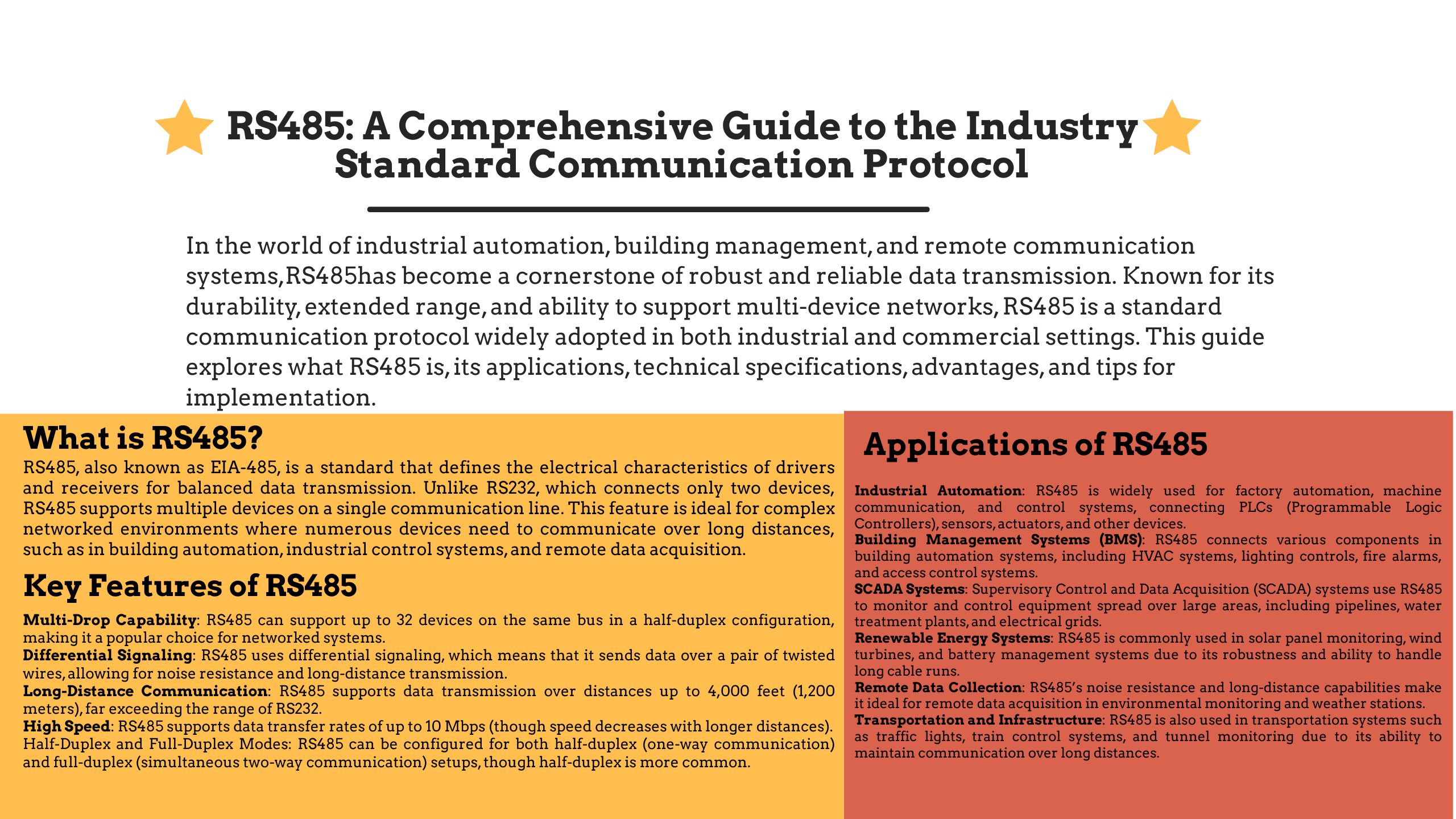
In the world of industrial automation, building management, and remote communication systems, RS485 has become a cornerstone of robust and reliable data transmission. Known for its durability, extended range, and ability to support multi-device networks, RS485 is a standard communication protocol widely adopted in both industrial and commercial settings. This guide explores what RS485 is, its applications, technical specifications, advantages, and tips for implementation.
What is RS485?
RS485, also known as EIA-485, is a standard that defines the electrical characteristics of drivers and receivers for balanced data transmission. Unlike RS232, which connects only two devices, RS485 supports multiple devices on a single communication line. This feature is ideal for complex networked environments where numerous devices need to communicate over long distances, such as in building automation, industrial control systems, and remote data acquisition.
RS485 is often used in conjunction with the Modbus protocol, a higher-level communication protocol that structures the data being exchanged, making it highly popular in industrial communication.
Key Features of RS485
- Multi-Drop Capability: RS485 can support up to 32 devices on the same bus in a half-duplex configuration, making it a popular choice for networked systems.
- Differential Signaling: RS485 uses differential signaling, which means that it sends data over a pair of twisted wires, allowing for noise resistance and long-distance transmission.
- Long-Distance Communication: RS485 supports data transmission over distances up to 4,000 feet (1,200 meters), far exceeding the range of RS232.
- High Speed: RS485 supports data transfer rates of up to 10 Mbps (though speed decreases with longer distances).
- Half-Duplex and Full-Duplex Modes: RS485 can be configured for both half-duplex (one-way communication) and full-duplex (simultaneous two-way communication) setups, though half-duplex is more common.
How RS485 Works
RS485 transmits data using a differential pair of wires (typically labeled A and B) that carry opposing signals. This differential signaling technique makes RS485 more resistant to electromagnetic interference (EMI) than other protocols. Because each signal travels on a separate wire and any external noise affects both lines equally, the system can filter out interference, leading to clearer and more reliable communication.
- Positive Signal (1) corresponds to Line A > Line B.
- Negative Signal (0) corresponds to Line B > Line A.
In an RS485 setup, devices are typically connected in a daisy-chain or bus topology, with terminators at each end of the network to prevent signal reflections. Termination resistors (usually around 120 ohms) are placed at each end of the transmission line, minimizing interference and ensuring signal integrity over long distances.
RS485 Topology Options
RS485 supports several network topologies that can be configured based on the requirements of the application:
- Bus Topology (Daisy Chain): Devices are connected in a linear sequence, allowing for simple and cost-effective installation. This is the most common topology for RS485 networks.
- Star Topology: Although less common, RS485 can be configured in a star topology with a central hub, though this configuration may require additional resistors or repeaters.
- Mixed Topology: A combination of daisy-chain and star topologies, where devices are arranged in multiple chains connected to a central point, suitable for more complex layouts.
RS485 Communication Modes: Half-Duplex vs. Full-Duplex
RS485 supports both half-duplex and full-duplex modes, allowing for flexibility depending on the application requirements.
- Half-Duplex (Two-Wire): In this configuration, data can only be transmitted in one direction at a time, meaning the devices must take turns sending and receiving data. This is the most common configuration for RS485 networks.
- Full-Duplex (Four-Wire): Full-duplex RS485 uses two pairs of wires, allowing data to flow in both directions simultaneously. However, full-duplex requires additional wiring and is less commonly implemented.
RS485 Wiring
Setting up RS485 wiring correctly is crucial to achieving stable and reliable communication. Here are some key considerations:
- Twisted Pair Cables: RS485 typically uses twisted pair cables, which helps cancel out electromagnetic interference. Using shielded twisted pair (STP) cables further reduces interference.
- Termination Resistors: Install a termination resistor (usually 120 ohms) at each end of the RS485 line to prevent signal reflections. These resistors ensure that signals do not bounce back along the cable, which can cause communication errors.
- Grounding: Proper grounding is essential in RS485 networks to avoid issues related to voltage differences between devices. Ground loops can introduce noise, so grounding all devices at the same point is recommended.
- Biasing Resistors: To keep the line in a known state when no device is transmitting, biasing resistors can be added to provide a default voltage differential. This helps prevent random noise from being interpreted as data.
- Network Topology: RS485 typically uses a bus (daisy chain) topology, which connects devices in a linear fashion. Star configurations should be avoided as they can cause reflections and degrade signal quality.
Applications of RS485
RS485 is used in numerous applications due to its resilience, range, and ability to support complex networks. Below are some of the most common uses:
- Industrial Automation: RS485 is widely used for factory automation, machine communication, and control systems, connecting PLCs (Programmable Logic Controllers), sensors, actuators, and other devices.
- Building Management Systems (BMS): RS485 connects various components in building automation systems, including HVAC systems, lighting controls, fire alarms, and access control systems.
- SCADA Systems: Supervisory Control and Data Acquisition (SCADA) systems use RS485 to monitor and control equipment spread over large areas, including pipelines, water treatment plants, and electrical grids.
- Renewable Energy Systems: RS485 is commonly used in solar panel monitoring, wind turbines, and battery management systems due to its robustness and ability to handle long cable runs.
- Remote Data Collection: RS485’s noise resistance and long-distance capabilities make it ideal for remote data acquisition in environmental monitoring and weather stations.
- Transportation and Infrastructure: RS485 is also used in transportation systems such as traffic lights, train control systems, and tunnel monitoring due to its ability to maintain communication over long distances.
Advantages of RS485
RS485 has several benefits that make it suitable for industrial and commercial applications:
- Long Distance Communication: RS485 can transmit data over distances up to 4,000 feet, which is significantly longer than RS232 and similar protocols.
- Noise Immunity: Thanks to differential signaling, RS485 is highly resistant to electromagnetic interference (EMI), making it ideal for noisy industrial environments.
- Multi-Device Support: RS485 can handle up to 32 devices on a single network, making it highly scalable.
- Flexibility in Configuration: RS485 supports half-duplex and full-duplex communication, allowing for versatile network setups.
- Cost-Effectiveness: With its simple wiring requirements and compatibility with low-cost hardware, RS485 is an economical solution for long-distance data transmission.
Disadvantages of RS485
Despite its many advantages, RS485 has some limitations that may impact its suitability for certain applications:
- Limited Device Addressing: Standard RS485 supports a maximum of 32 devices per network without repeaters, which can be limiting for large networks.
- Complex Network Setup: RS485 requires careful configuration of terminators and bias resistors to maintain signal integrity over long distances.
- No Error Detection or Correction: Unlike more advanced protocols, RS485 lacks built-in error detection and correction, which may necessitate additional software protocols to ensure data accuracy.
- Interference from Improper Termination: Failure to use proper termination resistors can cause signal reflections, leading to data errors.
Implementing RS485: Tips and Best Practices
Setting up an RS485 network requires attention to detail to ensure reliable and efficient communication. Here are some best practices to consider:
- Use Proper Termination: Place termination resistors (120 ohms) at each end of the RS485 line to prevent signal reflections and improve signal integrity.
- Avoid Star Topologies: RS485 works best in a daisy-chain or bus topology, so avoid creating star configurations that can introduce signal integrity issues.
- Use Shielded Twisted Pair Cable: Shielded twisted pair (STP) cable helps to reduce electromagnetic interference, ensuring cleaner data transmission.
- Check Biasing: Bias resistors can prevent a floating line by providing a stable idle state, helping to avoid spurious noise when the network is idle.
- Limit Cable Length and Speed: As cable length increases, reduce the baud rate (data speed) to maintain data accuracy over long distances.
- Monitor for Grounding Issues: Ground loops can introduce noise and disrupt communication, so ensure all devices on the RS485 bus are properly grounded.
Difference Between RS485 and RS232
While both RS485 and RS232 are serial communication protocols, they differ significantly in function, capabilities, and applications:
- Communication Range: RS485 supports long-distance communication up to 1,200 meters (4,000 feet), whereas RS232 is limited to about 15 meters (50 feet).
- Multi-Device Support: RS485 allows up to 32 devices on a single bus in a multi-drop configuration. RS232 only supports point-to-point communication between two devices.
- Signaling Method: RS485 uses differential (balanced) signaling, which provides better noise immunity, while RS232 uses single-ended (unbalanced) signaling, making it more susceptible to interference.
- Data Rate: RS232’s maximum data rate is typically limited to 20 kbps, while RS485 can support data rates up to 10 Mbps over short distances, though the rate decreases over longer cables.
- Applications: RS485 is favored in industrial environments, building automation, and large networks where reliable, long-distance communication is needed. RS232 is more commonly used for short-distance communication between devices like computers and peripherals.
| Feature | RS485 | RS232 |
|---|---|---|
| Communication Range | Up to 1,200 meters (4,000 feet) | Typically less than 15 meters (50 feet) |
| Multi-Device Support | Yes, up to 32 devices (expandable with repeaters) | No, limited to one-to-one connection |
| Differential Signaling | Yes, uses two wires with opposite signals for noise resistance | No, uses single-ended signaling |
| Data Transfer Rate | Up to 10 Mbps (decreases over long distances) | Up to 1 Mbps |
| Wiring Configuration | Two or four wires (half or full duplex) | Three wires (one data line and ground) |
| Noise Immunity | High, due to differential signaling | Low, prone to EMI interference |
| Topology | Bus or daisy-chain | Point-to-point only |
| Common Applications | Industrial automation, SCADA, Modbus, building management | Computers, modems, and point-to-point devices |
These distinctions make RS485 more suited for industrial applications, while RS232 remains popular for simpler, short-range connections.
RS485 vs. Other Communication Protocols
While RS485 has many advantages, it’s essential to understand how it compares to other common serial communication protocols:
- RS232: RS232 is limited to short-distance, point-to-point communication, typically less than 50 feet. It also doesn’t support multi-drop configurations, making it unsuitable for larger networks.
- Ethernet: Ethernet is faster and more suited for high-data applications, but it’s more expensive and complex to implement over long distances compared to RS485.
- Modbus: Modbus is a protocol often used over RS485 networks for industrial applications. It defines a structured way to communicate between devices, adding addressability and error-checking to RS485.
Difference Between RS485 and RS232
While both RS485 and RS232 are serial communication protocols, they differ significantly in function, capabilities, and applications:
- Communication Range: RS485 supports long-distance communication up to 1,200 meters (4,000 feet), whereas RS232 is limited to about 15 meters (50 feet).
- Multi-Device Support: RS485 allows up to 32 devices on a single bus in a multi-drop configuration. RS232 only supports point-to-point communication between two devices.
- Signaling Method: RS485 uses differential (balanced) signaling, which provides better noise immunity, while RS232 uses single-ended (unbalanced) signaling, making it more susceptible to interference.
- Data Rate: RS232’s maximum data rate is typically limited to 20 kbps, while RS485 can support data rates up to 10 Mbps over short distances, though the rate decreases over longer cables.
- Applications: RS485 is favored in industrial environments, building automation, and large networks where reliable, long-distance communication is needed. RS232 is more commonly used for short-distance communication between devices like computers and peripherals.
| Feature | RS485 | RS232 |
|---|---|---|
| Communication Range | Up to 1,200 meters (4,000 feet) | Typically less than 15 meters (50 feet) |
| Multi-Device Support | Yes, up to 32 devices (expandable with repeaters) | No, limited to one-to-one connection |
| Differential Signaling | Yes, uses two wires with opposite signals for noise resistance | No, uses single-ended signaling |
| Data Transfer Rate | Up to 10 Mbps (decreases over long distances) | Up to 1 Mbps |
| Wiring Configuration | Two or four wires (half or full duplex) | Three wires (one data line and ground) |
| Noise Immunity | High, due to differential signaling | Low, prone to EMI interference |
| Topology | Bus or daisy-chain | Point-to-point only |
| Common Applications | Industrial automation, SCADA, Modbus, building management | Computers, modems, and point-to-point devices |
These distinctions make RS485 more suited for industrial applications, while RS232 remains popular for simpler, short-range connections.
RS485 vs. Other Communication Protocols
While RS485 has many advantages, it’s essential to understand how it compares to other common serial communication protocols:
- RS232: RS232 is limited to short-distance, point-to-point communication, typically less than 50 feet. It also doesn’t support multi-drop configurations, making it unsuitable for larger networks.
- Ethernet: Ethernet is faster and more suited for high-data applications, but it’s more expensive and complex to implement over long distances compared to RS485.
- Modbus: Modbus is a protocol often used over RS485 networks for industrial applications. It defines a structured way to communicate between devices, adding addressability and error-checking to RS485.
What is the Modbus Protocol?
Modbus is a communication protocol commonly used with RS485 networks, particularly in industrial environments. While RS485 defines the physical and electrical interface, Modbus provides a structured way for devices to communicate, offering a standardized set of instructions for reading and writing data.
In an RS485 Modbus network, communication occurs between a master (host) device and slave (client) devices. The master sends queries, and each slave has a unique address, responding only to requests directed at it. This structure helps organize data transmission and allows multiple devices to coexist on the same RS485 network without conflict.
Modbus supports two transmission modes:
- RTU (Remote Terminal Unit): Data is transmitted in binary, providing higher efficiency.
- ASCII: Data is transmitted in ASCII, which is easier to monitor but slower than RTU.
Modbus’s use with RS485 is advantageous due to its simplicity and compatibility with various industrial devices, making it a universal choice for device control and monitoring.
RS485 and Modbus: A Powerful Combination
One of the most popular applications of RS485 is in Modbus networks. Modbus is a protocol that enables communication between multiple devices on the same network, allowing each device to have a unique address. RS485’s robustness and long-distance capability make it a perfect transport layer for Modbus, commonly used in SCADA systems, industrial automation, and building management.
The Future of RS485
RS485 is designed to be versatile, robust, and adaptable to various communication needs. Key features of RS485 include:
- Multi-Device Support: It allows up to 32 devices (or nodes) to be connected on a single network, which can be expanded with repeaters.
- Long Transmission Distance: RS485 supports data transmission over distances up to 1,200 meters (4,000 feet), a significant advantage over shorter-range protocols like RS232.
- Differential Signaling: RS485 uses a balanced differential signal to improve noise immunity, making it ideal for noisy environments.
- High Data Rates: The maximum data rate for RS485 is 10 Mbps for short distances, though data rates are typically lower as distance increases.
- Half-Duplex and Full-Duplex Modes: It can operate in both half-duplex and full-duplex modes, providing flexibility depending on the application needs. Most RS485 implementations use half-duplex (two-wire) mode.
These features make RS485 a preferred choice for stable, long-distance communication in demanding industrial applications.
Conclusion
RS485 remains one of the most reliable and widely used communication standards
for industrial and commercial applications. Its long-distance capability, noise immunity, and multi-drop support make it ideal for complex, large-scale networks that need to transmit data accurately over significant distances. By following best practices and leveraging the strengths of RS485, engineers and system integrators can design effective, robust, and cost-efficient communication networks for a wide range of applications.