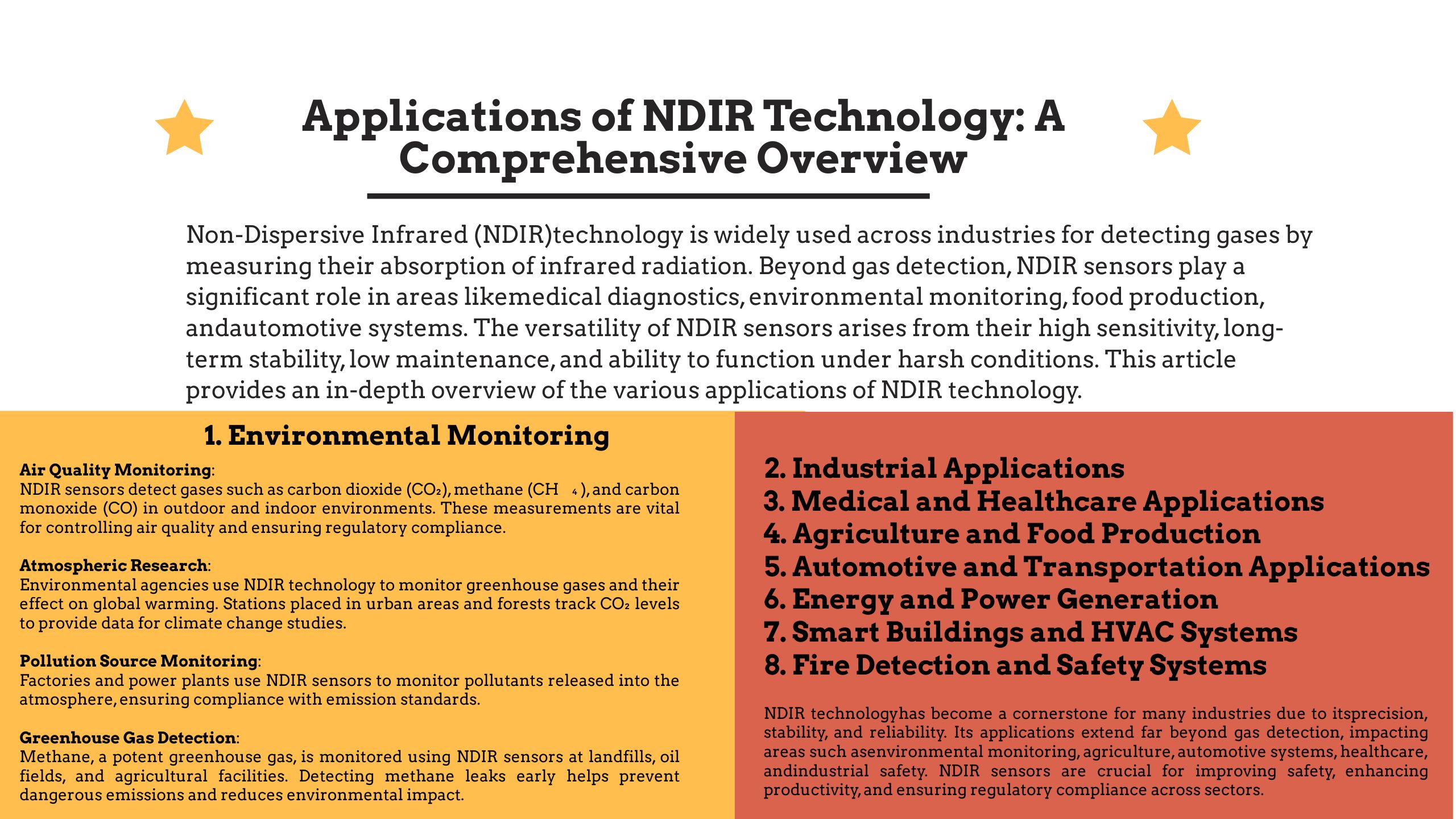
Non-Dispersive Infrared (NDIR) technology is widely used across industries for detecting gases by measuring their absorption of infrared radiation. Beyond gas detection, NDIR sensors play a significant role in areas like medical diagnostics, environmental monitoring, food production, and automotive systems. The versatility of NDIR sensors arises from their high sensitivity, long-term stability, low maintenance, and ability to function under harsh conditions. This article provides an in-depth overview of the various applications of NDIR technology.
1. Environmental Monitoring
One of the most critical applications of NDIR technology is environmental monitoring, where it helps measure and control air quality, greenhouse gas emissions, and pollutant levels.
- Air Quality Monitoring:
NDIR sensors detect gases such as carbon dioxide (CO₂), methane (CH₄), and carbon monoxide (CO) in outdoor and indoor environments. These measurements are vital for controlling air quality and ensuring regulatory compliance. - Atmospheric Research: Environmental agencies use NDIR technology to monitor greenhouse gases and their effect on global warming. Stations placed in urban areas and forests track CO₂ levels to provide data for climate change studies.
- Pollution Source Monitoring: Factories and power plants use NDIR sensors to monitor pollutants released into the atmosphere, ensuring compliance with emission standards.
- Greenhouse Gas Detection:
Methane, a potent greenhouse gas, is monitored using NDIR sensors at landfills, oil fields, and agricultural facilities. Detecting methane leaks early helps prevent dangerous emissions and reduces environmental impact.
2. Industrial Applications
NDIR sensors are crucial in industrial safety, process control, and equipment monitoring. Industries rely on NDIR technology to ensure worker safety, optimize production, and detect hazardous gases.
- Gas Leak Detection:
NDIR-based systems detect leaks of flammable or toxic gases like methane or carbon monoxide in chemical plants, refineries, and oil rigs. These sensors provide real-time alerts, allowing immediate action to prevent accidents. - Combustion Control:
Industrial furnaces and boilers use NDIR sensors to monitor combustion by measuring the concentration of CO and CO₂. This data helps maintain optimal combustion conditions, reducing fuel consumption and minimizing emissions. - Refrigerant Leak Detection:
In air conditioning and refrigeration systems, NDIR sensors detect refrigerant leaks. Refrigerants are harmful to the environment, and early leak detection ensures regulatory compliance and prevents energy losses.
3. Medical and Healthcare Applications
In the healthcare sector, NDIR sensors play a crucial role in diagnostics, anesthesia monitoring, and air quality control. Their accuracy and reliability make them indispensable in critical care settings.
- Capnography:
NDIR sensors are used in capnographs to monitor CO₂ levels in patients’ exhaled air during surgeries or mechanical ventilation. This helps healthcare providers assess the patient’s respiratory status and ensure proper ventilation. - Anesthesia Gas Monitoring:
Anesthesia machines use NDIR technology to measure the concentration of anesthetic gases like nitrous oxide. This ensures that patients receive the correct dosage, preventing both underdosing and overdosing. - Indoor Air Quality in Hospitals:
NDIR sensors monitor CO₂ levels and air quality in healthcare facilities to maintain a healthy environment. Proper ventilation prevents the spread of airborne pathogens, contributing to patient and staff well-being. - Respiratory Diagnostics:
Advanced diagnostic equipment uses NDIR technology to measure gases like methane or hydrogen in breath samples to detect gastrointestinal disorders.
4. Agriculture and Food Production
NDIR technology plays a vital role in agriculture and food processing, helping maintain optimal growing conditions and extending the shelf life of perishable goods.
- Greenhouse CO₂ Monitoring:
NDIR sensors control CO₂ levels in greenhouses to enhance plant growth. Automated ventilation and fertilization systems use NDIR readings to maintain an ideal growing environment, improving crop yield and quality. - Modified Atmosphere Packaging (MAP):
In food packaging, NDIR sensors ensure the proper balance of gases (e.g., CO₂ and O₂) to extend the shelf life of products like meat, vegetables, and dairy. The correct gas composition prevents spoilage and maintains food freshness. - Fermentation Monitoring:
During the production of beer, wine, and other fermented foods, NDIR sensors monitor CO₂ levels. This ensures consistency in the fermentation process and helps maintain product quality. - Controlled Atmosphere Storage:
NDIR technology helps manage gas concentrations in storage units for fruits and vegetables. This reduces spoilage, extends shelf life, and minimizes waste.
5. Automotive and Transportation Applications
NDIR sensors are widely used in the automotive industry to monitor emissions, improve air quality inside vehicles, and ensure safety in transportation systems.
- Vehicle Emissions Monitoring:
NDIR sensors are integrated into exhaust gas analyzers to measure emissions such as CO, CO₂, and hydrocarbons. This ensures that vehicles meet environmental standards and reduces air pollution. - Cabin Air Quality Control:
Modern vehicles use NDIR sensors to monitor CO₂ levels inside the cabin. The air conditioning system adjusts ventilation automatically to maintain fresh air and improve passenger comfort. - Refrigerated Transport Monitoring:
Refrigerated trucks and shipping containers use NDIR technology to monitor gas concentrations inside the cargo area. This ensures that goods are stored under optimal conditions during transport.
6. Energy and Power Generation
In biogas plants and power generation facilities, NDIR sensors are essential for monitoring gases like methane, ensuring safety and optimizing energy production.
- Biogas Production Monitoring:
NDIR sensors measure the concentration of methane (CH₄) and carbon dioxide (CO₂) in biogas plants. This helps maintain the efficiency of anaerobic digesters and ensures safe operation. - Power Plant Emission Monitoring:
Power plants use NDIR sensors to monitor CO and CO₂ emissions, ensuring compliance with environmental regulations. This data is also used to improve combustion efficiency and reduce fuel consumption.
7. Smart Buildings and HVAC Systems
NDIR sensors are integral to HVAC systems and smart buildings, helping maintain air quality, control ventilation, and optimize energy use.
- Demand-Controlled Ventilation (DCV):
NDIR sensors monitor CO₂ levels in offices, classrooms, and auditoriums. Ventilation systems automatically adjust airflow based on occupancy levels, improving air quality and reducing energy consumption. - Smart Air Purifiers:
Air purifiers equipped with NDIR sensors monitor indoor air quality and adjust filtration levels to remove pollutants, ensuring a healthy environment.
8. Fire Detection and Safety Systems
NDIR sensors are also used in early fire detection and safety systems.
- Fire Suppression Systems:
Some fire suppression systems use NDIR sensors to detect gas build-ups that may indicate a potential fire hazard. This allows for early intervention and prevents accidents. - Toxic Gas Monitoring:
NDIR technology is used in confined spaces to detect toxic gases like CO. In case of dangerous gas levels, safety alarms are triggered to protect workers and occupants.
Conclusion
NDIR technology has become a cornerstone for many industries due to its precision, stability, and reliability. Its applications extend far beyond gas detection, impacting areas such as environmental monitoring, agriculture, automotive systems, healthcare, and industrial safety. NDIR sensors are crucial for improving safety, enhancing productivity, and ensuring regulatory compliance across sectors.
With advances in IoT integration, miniaturization, and energy efficiency, NDIR sensors are becoming even more versatile. As industries continue to prioritize sustainability, health, and safety, the role of NDIR technology will only grow, further expanding its applications in both familiar and new domains.