
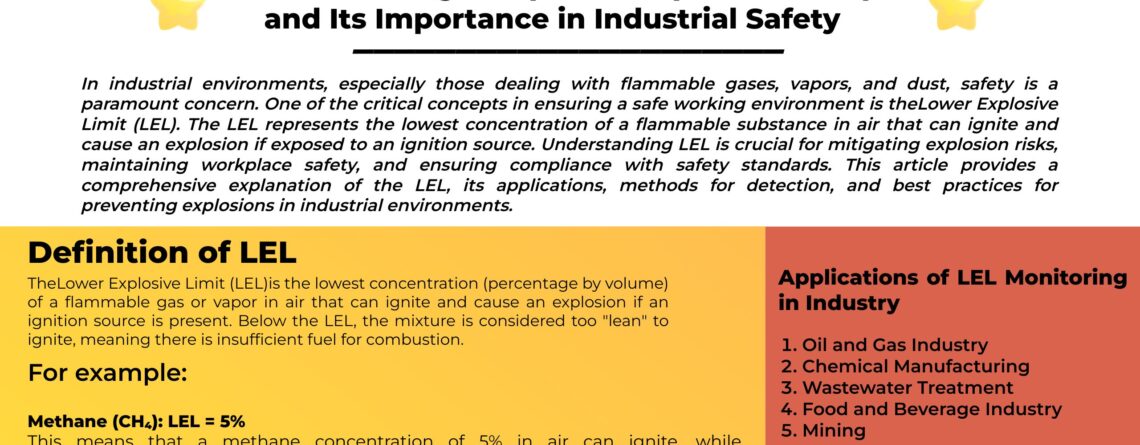
In industrial environments, especially those dealing with flammable gases, vapors, and dust, safety is a paramount concern. One of the critical concepts in ensuring a safe working environment is the Lower Explosive Limit (LEL). The LEL represents the lowest concentration of a flammable substance in air that can ignite and cause an explosion if exposed to an ignition source. Understanding LEL is crucial for mitigating explosion risks, maintaining workplace safety, and ensuring compliance with safety standards. This article provides a comprehensive explanation of the LEL, its applications, methods for detection, and best practices for preventing explosions in industrial environments.
1. What is LEL?
1.1 Definition of LEL
The Lower Explosive Limit (LEL) is the lowest concentration (percentage by volume) of a flammable gas or vapor in air that can ignite and cause an explosion if an ignition source is present. Below the LEL, the mixture is considered too “lean” to ignite, meaning there is insufficient fuel for combustion.
For example:
- Methane (CH₄): LEL = 5%
This means that a methane concentration of 5% in air can ignite, while concentrations below this are too lean to support combustion. - Propane (C₃H₈): LEL = 2.1%
Propane requires only 2.1% concentration in air to reach its LEL.
1.2 Upper Explosive Limit (UEL)
In contrast to the LEL, the Upper Explosive Limit (UEL) is the highest concentration of a gas or vapor in air that can ignite. Above the UEL, the mixture is too “rich” to burn because there is insufficient oxygen. The flammable range is the difference between the LEL and UEL.
Example for Methane:
- LEL = 5%
- UEL = 15%
Thus, methane is flammable between 5% and 15% concentration in air.
1.3 Why LEL is Important
Understanding and monitoring the LEL is crucial for preventing explosions in industries where flammable substances are present. Whether in oil and gas refineries, chemical plants, or confined spaces, LEL measurements help detect dangerous concentrations of gases and prevent catastrophic accidents.
2. Common Flammable Substances and Their LELs
The table below shows the LEL values for some commonly encountered gases and vapors in industrial environments:
| Substance | LEL (%) | UEL (%) | Flammable Range (%) |
|---|---|---|---|
| Methane (CH₄) | 5.0 | 15.0 | 10.0 |
| Propane (C₃H₈) | 2.1 | 9.5 | 7.4 |
| Ethanol (C₂H₅OH) | 3.3 | 19.0 | 15.7 |
| Hydrogen (H₂) | 4.0 | 75.0 | 71.0 |
| Acetylene (C₂H₂) | 2.5 | 100.0 | 97.5 |
| Ammonia (NH₃) | 15.0 | 28.0 | 13.0 |
These substances are commonly found in various industries and can pose serious risks if not properly monitored.
3. Applications of LEL Monitoring in Industry
3.1 Oil and Gas Industry
In oil and gas facilities, flammable gases such as methane and propane are frequently present. LEL monitoring is essential to prevent explosions during drilling, refining, and storage processes. Fixed and portable gas detectors help maintain safe operations by providing real-time LEL readings.
3.2 Chemical Manufacturing
Chemical plants handle a variety of flammable substances, including solvents and hydrocarbons. Monitoring LEL levels is critical for avoiding explosions, particularly in areas where chemicals are mixed, stored, or processed.
3.3 Wastewater Treatment
In wastewater treatment plants, methane and hydrogen sulfide (H₂S) are common byproducts. Methane can accumulate in confined spaces such as digesters and tanks, reaching explosive concentrations if not properly ventilated and monitored.
3.4 Food and Beverage Industry
The food and beverage industry may also require LEL monitoring, especially in processes involving alcohol fermentation or where carbon dioxide and ethanol vapors can accumulate in enclosed spaces.
3.5 Mining
In underground mining operations, gases such as methane (commonly known as fire damp) pose a serious explosion risk. Continuous LEL monitoring is vital to detect dangerous gas accumulations and ensure the safety of miners.
4. How LEL is Measured
4.1 Catalytic Bead Sensors
Catalytic bead sensors are among the most commonly used devices for measuring LEL levels. These sensors operate by oxidizing the flammable gas on a heated bead, causing a change in resistance that correlates with the gas concentration.
Advantages:
- Accurate and reliable
- Suitable for a wide range of flammable gases
Disadvantages:
- Requires oxygen to function
- Can be poisoned by certain substances (e.g., silicone, sulfur compounds)
4.2 Infrared (IR) Sensors
Infrared sensors measure gas concentration by detecting the absorption of infrared light at specific wavelengths.
Advantages:
- Does not require oxygen to operate
- Resistant to poisoning
- Suitable for harsh environments
Disadvantages:
- Limited to gases that absorb infrared light (e.g., methane, propane)
4.3 Semiconductor Sensors
Semiconductor sensors detect gases by measuring changes in conductivity caused by gas interactions with a metal oxide surface.
Advantages:
- Low cost
- Compact and lightweight
Disadvantages:
- Less accurate compared to catalytic bead and IR sensors
- Sensitive to humidity and temperature changes
5. Safety Practices for Managing LEL Risks
5.1 Ventilation
Proper ventilation is one of the most effective ways to prevent the buildup of flammable gases and reduce the risk of reaching the LEL. Mechanical ventilation systems should be installed in areas where flammable substances are used or stored.
5.2 Gas Detection Systems
Installing fixed and portable gas detectors that monitor LEL levels is crucial for maintaining a safe working environment. These devices should be regularly calibrated and maintained to ensure accuracy.
5.3 Employee Training
Workers should be trained to understand LEL values, recognize the risks associated with flammable gases, and respond appropriately to alarms. Regular safety drills can help reinforce these practices.
5.4 Hazardous Area Classification
Classifying areas based on the likelihood of flammable gas presence helps determine the necessary precautions and equipment to use. For example, electrical equipment in hazardous areas should be explosion-proof to prevent ignition.
5.5 Emergency Response Plans
Developing and implementing comprehensive emergency response plans is essential for handling incidents where gas concentrations exceed the LEL. These plans should include evacuation procedures, communication protocols, and steps for mitigating explosions.
6. Regulatory Standards and Compliance
Several organizations have established standards for monitoring and managing LEL risks:
- OSHA (Occupational Safety and Health Administration): Sets permissible exposure limits and safety guidelines for flammable substances.
- NFPA (National Fire Protection Association): Provides standards for fire prevention and explosion protection in hazardous environments.
- IEC (International Electrotechnical Commission): Specifies requirements for electrical equipment used in hazardous areas (e.g., IEC 60079).
- ATEX (Atmosphères Explosibles): European directive for equipment used in explosive atmospheres.
Compliance with these standards is essential for ensuring workplace safety and avoiding legal penalties.
7. Conclusion
The Lower Explosive Limit (LEL) is a vital concept for maintaining safety in industries that deal with flammable gases and vapors. Understanding and monitoring LEL levels help prevent explosions, protect workers, and ensure the continuity of operations. Advances in gas detection technology have made it easier to monitor LEL levels in real time, reducing the risks associated with flammable gases. By implementing proper safety practices, using reliable gas detection systems, and complying with regulatory standards, industries can create safer and more efficient working environments.
Whether in oil refineries, chemical plants, or wastewater treatment facilities, the importance of LEL monitoring cannot be overstated. As technology continues to evolve, we can expect even more robust and reliable solutions for mitigating explosion risks and ensuring workplace safety.






Leave a Reply