
In the realms of engineering, manufacturing, construction, automotive industries, and even consumer electronics, vibration sensing plays an essential role. Vibration Sensors are critical tools that help in monitoring equipment health, predicting failures, ensuring safety, improving design, and optimizing processes.
Vibrations can indicate a range of phenomena — from minor imbalances and misalignments to impending catastrophic failures. Detecting and analyzing these vibrations accurately enables timely maintenance and significant cost savings.
This comprehensive guide dives deep into vibration sensors: what they are, how they work, their types, applications, benefits, limitations, and emerging trends.
1. What Is a Vibration Sensor?
A vibration sensor, also known as a vibration detector, vibration analyzer, or accelerometer (depending on the specific type), is a device that measures the vibration level, frequency, or motion of an object or system.
It converts mechanical movement (vibrations) into an electrical signal that can be monitored, recorded, and analyzed. Based on the data collected, users can determine equipment health, detect anomalies, and take preventive actions.
Vibration sensors are fundamental in predictive maintenance (PdM) and condition monitoring (CM) strategies across industries.
2. How Vibration Sensors Work
2.1 The Basic Principle

(power-mi.com)
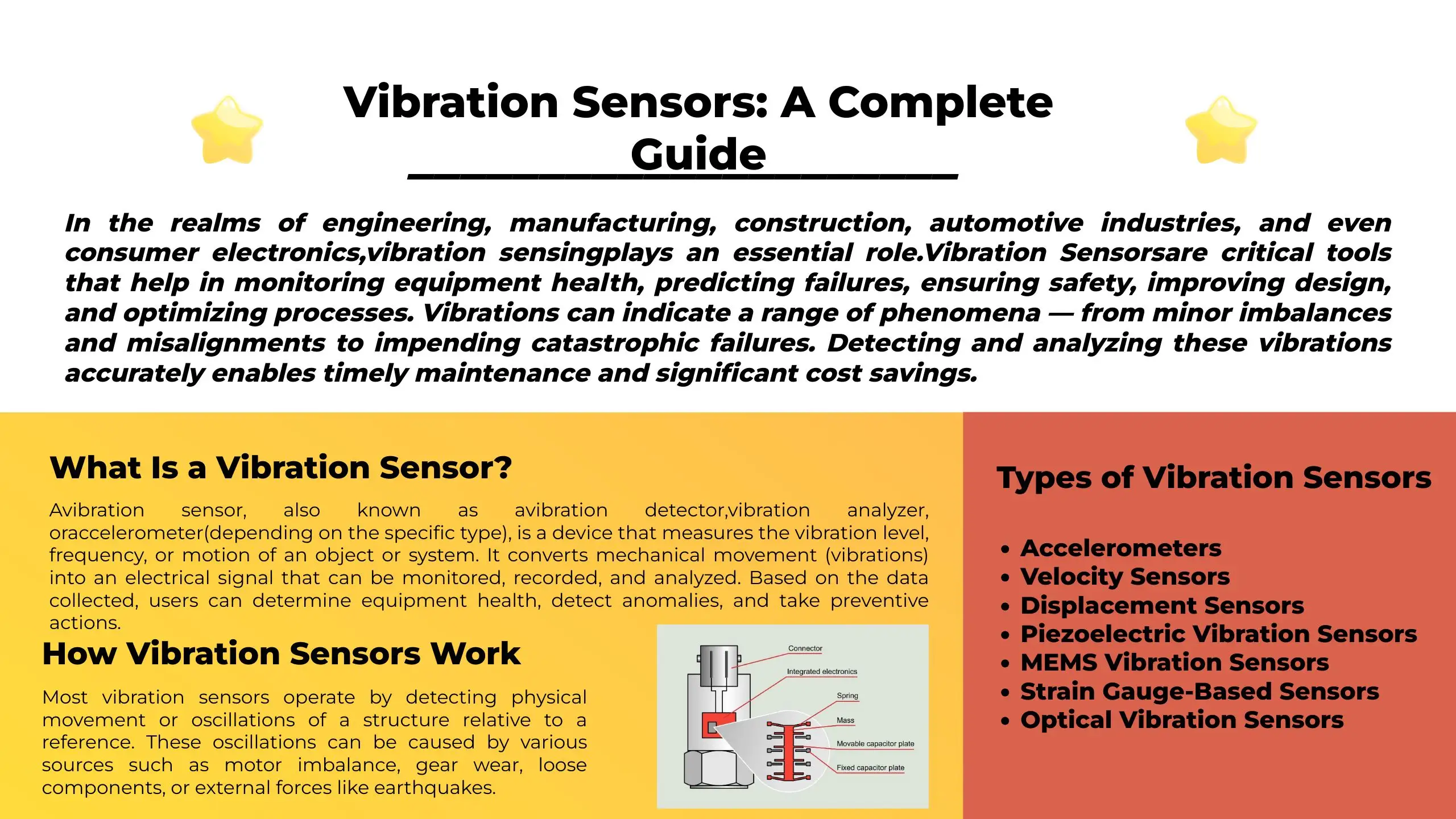
Most vibration sensors operate by detecting physical movement or oscillations of a structure relative to a reference. These oscillations can be caused by various sources such as motor imbalance, gear wear, loose components, or external forces like earthquakes.
The sensor typically measures:
- Amplitude (size of the vibration)
- Frequency (rate of vibration)
- Velocity (rate of displacement change)
- Acceleration (rate of velocity change)
Depending on the sensor type, different transduction mechanisms are used:
- Piezoelectric effect (voltage generation under mechanical stress)
- Capacitive sensing (distance changes between conductive plates)
- Optical sensing (light reflection or refraction changes)
- Resistive sensing (change in resistance due to deformation)
3. Types of Vibration Sensors
3.1 Accelerometers
- Measure acceleration forces resulting from vibration.
- Available in piezoelectric, capacitive, MEMS, and piezoresistive varieties.
- Wide frequency range, ideal for machine monitoring.
3.2 Velocity Sensors
- Measure the speed of vibration.
- Commonly used for medium-frequency applications.
- Often used in rotating equipment monitoring.
3.3 Displacement Sensors
- Measure the distance an object moves.
- Suitable for low-frequency or static vibration detection.
- Typically use proximity probes or capacitive sensors.
3.4 Piezoelectric Vibration Sensors
- Utilize the piezoelectric effect to produce an electric charge when subjected to mechanical stress.
- High-frequency range.
- No external power needed (self-generating).
3.5 MEMS Vibration Sensors
- Micro-Electro-Mechanical Systems.
- Tiny sensors ideal for portable electronics, IoT devices, and wearables.
- Low power consumption.
3.6 Strain Gauge-Based Sensors
- Detect minute changes in strain caused by vibrations.
- Used where high sensitivity is necessary.
3.7 Optical Vibration Sensors
- Use laser interferometry or fiber optics to measure tiny displacements.
- Non-contact and extremely precise.
4. Key Specifications of Vibration Sensors
When choosing a vibration sensor, important parameters include:
- Frequency Range: Operational bandwidth.
- Sensitivity: Electrical output per unit of measured vibration.
- Dynamic Range: Range over which the sensor accurately measures vibrations.
- Resonant Frequency: Frequency at which the sensor itself vibrates.
- Temperature Range: Operational environmental conditions.
- Mounting Options: Screw, adhesive, magnetic, or clip mounting.
- Power Requirements: Whether external power is needed.
5. Applications of Vibration Sensors
5.1 Industrial Equipment Monitoring
- Motors, pumps, compressors, turbines.
- Detects imbalance, misalignment, bearing faults.
5.2 Predictive Maintenance
- Early detection of faults prevents downtime.
- Reduces repair costs and increases equipment lifespan.
5.3 Structural Health Monitoring
- Bridges, buildings, dams.
- Assesses structural integrity and early damage detection.
5.4 Automotive Industry
- Engine vibration analysis.
- Suspension system testing.
- Crash detection systems.
5.5 Aerospace Industry
- Aircraft engine monitoring.
- Vibration analysis for structural components.
5.6 Consumer Electronics
- Mobile phones, game controllers (vibration feedback).
- Wearable devices for activity and posture monitoring.
5.7 Earthquake Detection
- Seismometers use specialized vibration sensors to detect seismic activity.
5.8 Medical Devices
- Monitoring vibrations for prosthetic limb feedback.
- Diagnostic devices for respiratory and cardiac conditions.
6. Mounting Techniques for Vibration Sensors
Proper mounting is crucial for accurate vibration measurement:
- Stud Mounting: Direct attachment with screws; best for high-frequency measurements.
- Adhesive Mounting: Easy but may affect high-frequency response.
- Magnetic Mounting: Temporary and flexible; best for non-permanent installations.
- Handheld/Probe-Based: Used for spot-checking equipment.
Each method affects the measurement’s frequency response, so selection depends on the application.
7. Advantages of Vibration Sensors
7.1 Early Fault Detection
- Identifies problems before catastrophic failure occurs.
7.2 Non-Invasive Monitoring
- Measures without interfering with machine operation.
7.3 Versatility
- Applicable to a wide range of equipment and structures.
7.4 Predictive Maintenance Enablement
- Facilitates PdM strategies, reducing downtime and costs.
7.5 High Sensitivity and Accuracy
- Capable of detecting minute vibrations.
8. Limitations and Challenges
8.1 Cost
- High-quality sensors and systems can be expensive.
8.2 Environmental Interference
- Temperature changes, dust, moisture, and electromagnetic fields can affect accuracy.
8.3 Installation Complexity
- Proper placement and alignment are critical for accurate data.
8.4 Data Overload
- Large amounts of vibration data require robust processing and interpretation systems.
9. Signal Processing in Vibration Sensors
Once vibration is converted into an electrical signal, advanced signal processing techniques are used to:
- Filter out noise.
- Extract meaningful features (amplitude, frequency content).
- Perform time-domain and frequency-domain analyses (e.g., FFT).
Machine learning algorithms are increasingly used to classify patterns and predict maintenance needs.
10. Trends in Vibration Sensor Technology
10.1 Wireless Vibration Sensors
- Easier installation.
- Suitable for hard-to-reach or moving parts.
10.2 IoT and Cloud Integration
- Remote monitoring and real-time analytics.
10.3 Artificial Intelligence (AI)
- Predictive analytics based on historical vibration patterns.
10.4 Miniaturization
- MEMS technology enables tiny sensors with big capabilities.
10.5 Energy Harvesting Sensors
- Sensors powered by the vibrations they measure.
11. Future of Vibration Sensors
As industries move toward Industry 4.0 and smart manufacturing, vibration sensors will become even more critical. Expected future developments include:
- Self-diagnosing sensors.
- Fully integrated sensor systems with machine learning algorithms onboard.
- Wider adoption in consumer applications like smart homes and health monitoring.
The convergence of advanced materials, edge computing, and 5G will accelerate these innovations.
12. Choosing the Right Vibration Sensor
When selecting a vibration sensor, consider:
- Nature of the vibration: Random, harmonic, or impact?
- Amplitude and frequency: Expected range?
- Environmental conditions: Temperature, humidity, dust, electromagnetic interference?
- Mounting constraints: Accessibility, permanence, vibration transmission path.
- Budget and lifespan expectations: High-end vs low-cost solutions.
Common questions during selection include:
- Do I need wired or wireless?
- How critical is high-frequency detection?
- Will I be monitoring continuously or spot-checking?
13. Example Use Case: Vibration Monitoring of an Industrial Motor
Problem: Unexpected motor failures causing production downtime.
Solution:
- Install piezoelectric accelerometers on the motor housing.
- Use wireless data transmission to a central monitoring system.
- Set up real-time alerts for abnormal vibration levels.
- Perform FFT analysis to isolate frequency components corresponding to bearing wear.
Result:
- Early detection of worn bearings.
- Preventive maintenance scheduling.
- Reduced downtime and repair costs.
Conclusion
Vibration sensors are indispensable tools in today’s data-driven, maintenance-focused, and safety-conscious world. They serve as the “early warning systems” across countless applications, helping industries and individuals to prevent damage, optimize performance, and save costs.
While challenges remain in installation, environmental robustness, and data management, advances in materials, signal processing, AI, and IoT integration are rapidly overcoming these hurdles.
The future is bright for vibration sensing technology — smarter, smaller, more connected, and more accurate than ever before.
Whether you’re managing a wind farm, designing a spacecraft, maintaining a factory, or simply making smartphones smarter, vibration sensors are the quiet sentinels ensuring reliability, safety, and efficiency.
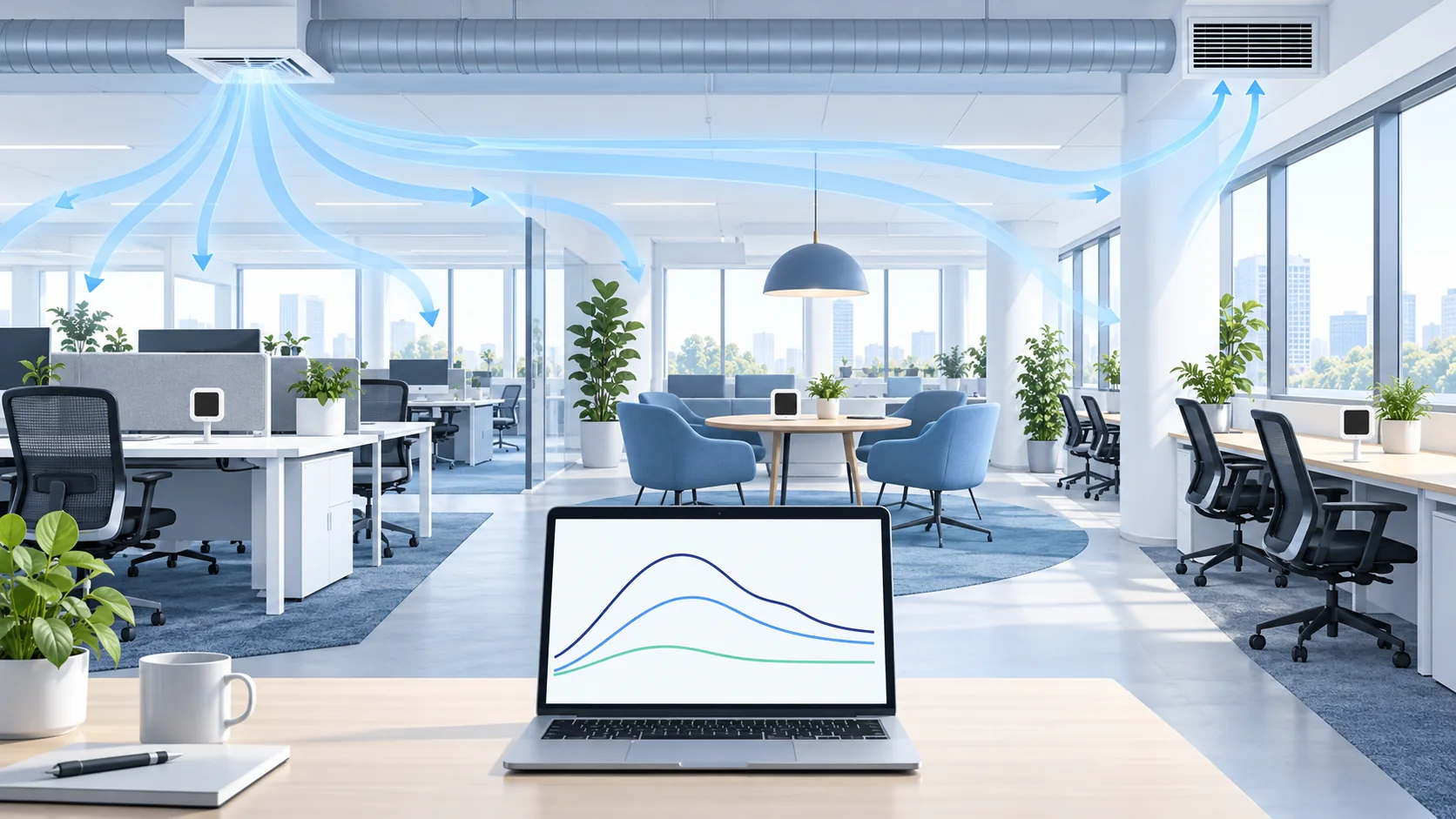
How to Compare CO2 Readings Across Open-Plan Office Zones
Compare synchronized office-zone CO2 logs after checking monitor agreement, location, occupancy and air-system events; learn when a zone difference warrants investigation.
Read More
How to Read a Meeting Room CO2 Trend Against Occupancy
Read meeting-room CO2 trends with occupancy and ventilation events, distinguishing starting level, occupied rise, intervention and post-meeting decline.
Read More
How to Plan CO2 Monitor Placement in an Office
Plan representative office CO2 monitor locations by measurement purpose, occupancy and air paths, then verify positions and log context before using the data.
Read More
Do Air Purifiers Lower CO2? Separate Filtration from Outdoor-Air Exchange
Ordinary HEPA purifiers capture particles but do not meaningfully remove occupant-generated CO2. Learn to separate recirculation, outdoor-air ventilation and monitor mixing effects.
Read More
How to Read an Overnight Bedroom CO2 Log
Interpret an overnight bedroom CO2 trace using its starting level, rise, plateau and morning response while checking logger quality, air paths and comparable nights.
Read More
How to Interpret CO2 Trends at Home: Read the Pattern, Not One Number
Learn how occupancy, outdoor air, room mixing and monitor placement shape a home CO2 trace, and use a repeatable log to test ventilation changes.
Read More