Oxygen sensing plays a crucial role in various industrial, automotive, medical, and environmental applications. Among the different types of oxygen sensors, zirconia oxygen sensors are widely used due to their high accuracy, fast response time, and durability. These sensors utilize zirconium dioxide (ZrO₂) as the sensing material and operate based on electrochemical principles.

Zirconia oxygen sensors are commonly found in automotive exhaust systems, industrial combustion control, medical oxygen monitoring, and environmental applications. Their ability to measure oxygen concentration with precision makes them indispensable in modern technology.

This article will cover the working principle, types, applications, advantages, limitations, and future developments of zirconia oxygen sensors.

What is a Zirconia Oxygen Sensor?

A zirconia oxygen sensor is an electrochemical device that measures oxygen concentration in gases, typically using zirconium dioxide (ZrO₂) as a solid electrolyte. These sensors are widely used in environments where oxygen measurement is critical, such as in automotive exhaust systems, industrial combustion control, and medical oxygen monitoring.

The sensor operates by utilizing the ionic conductivity of zirconium dioxide at high temperatures, allowing the measurement of oxygen partial pressure differences between two gas environments. This produces an electrical signal that correlates with oxygen concentration.

Working Principle of Zirconia Oxygen Sensors

1. Role of Zirconium Dioxide (ZrO₂)

Zirconium dioxide is a ceramic material that becomes oxygen-ion conductive at high temperatures (typically above 600°C). This property allows oxygen ions to migrate through the material, enabling oxygen concentration measurements.

2. Electrochemical Reaction and Nernst Equation

A zirconia oxygen sensor consists of:

  • A solid electrolyte (zirconia ceramic) stabilized with yttria to enhance oxygen ion conductivity.
  • Two platinum electrodes, one exposed to the reference gas (typically ambient air) and the other to the gas being measured.
  • A heater element to maintain the required operating temperature.

At high temperatures, the zirconia electrolyte allows oxygen ions (O²⁻) to migrate from areas of high oxygen concentration to areas of low oxygen concentration. This migration generates a voltage difference between the electrodes, which is governed by the Nernst equation:
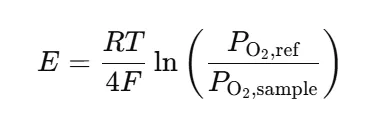
Nernst Equation

Where:

  • EE = Output voltage of the sensor
  • RR = Universal gas constant
  • TT = Temperature in Kelvin
  • FF = Faraday’s constant
  • PO2,ref = Partial pressure of oxygen in the reference gas
  • PO2,sample = Partial pressure of oxygen in the sample gas

By measuring the voltage output, the oxygen concentration in the sample gas can be determined.
Types of Zirconia Oxygen Sensors

1. Binary (Switch-Type) Zirconia Oxygen Sensors

  • Also known as lambda sensors, these are used in automotive engines to monitor air-fuel ratio.
  • They provide a switching voltage (around 0.1V to 0.9V) depending on whether the mixture is rich (excess fuel) or lean (excess oxygen).
  • Used for closed-loop fuel control in gasoline engines to optimize combustion and reduce emissions.

2. Wideband (Linear) Zirconia Oxygen Sensors

  • Provide a continuous measurement of oxygen concentration rather than a binary output.
  • Used in advanced engine control systems, industrial combustion monitoring, and scientific research.
  • Can measure oxygen concentration over a wide range, allowing precise air-fuel ratio adjustments.

3. Exhaust Gas Zirconia Sensors

  • Designed specifically for industrial combustion processes, power plants, and boiler systems.
  • Help optimize fuel efficiency and minimize pollutants by continuously measuring oxygen levels in flue gases.

4. Medical Zirconia Oxygen Sensors

  • Used in ventilators, anesthesia machines, and oxygen concentrators to ensure accurate oxygen delivery in medical applications.
  • Provide real-time oxygen concentration monitoring in respiratory devices.

5. Environmental and Industrial Zirconia Oxygen Sensors

  • Used in atmospheric monitoring, fire prevention systems, and oxygen-sensitive industrial processes such as steel manufacturing.
  • Provide high-accuracy oxygen measurements in controlled environments.

Applications of Zirconia Oxygen Sensors

1. Automotive Industry

  • Used in internal combustion engines for air-fuel ratio control.
  • Helps optimize fuel efficiency and reduce harmful emissions such as CO, NOₓ, and hydrocarbons.
  • Essential for compliance with emission regulations (e.g., Euro 6, EPA standards).

2. Industrial Combustion Control

  • Used in boilers, furnaces, and power plants to monitor and optimize combustion efficiency.
  • Helps reduce fuel consumption and minimize pollutant emissions.

3. Medical Devices

  • Monitors oxygen concentration in ventilators, anesthesia machines, and incubators.
  • Ensures safe and precise oxygen delivery for patients in critical care.

4. Environmental Monitoring

  • Detects oxygen levels in air quality monitoring stations and fire prevention systems.
  • Used in high-altitude research and atmospheric studies.

5. Aerospace and Aviation

  • Monitors cabin oxygen levels in aircraft for passenger safety.
  • Used in space exploration to control oxygen environments in spacecraft and habitats.

Advantages of Zirconia Oxygen Sensors

  • High Accuracy: Provides precise oxygen measurements.
  • Fast Response Time: Can quickly adjust to changes in oxygen levels.
  • Durability: Can operate in harsh conditions (high temperatures, corrosive gases).
  • Long Lifespan: Compared to other sensor types, zirconia sensors offer extended service life.
  • Low Power Consumption: Suitable for battery-powered and embedded systems.
  • Wide Measurement Range: Capable of detecting both high and low oxygen concentrations.

Limitations of Zirconia Oxygen Sensors

  • High Operating Temperature: Requires a heater to maintain ionic conductivity.
  • Susceptible to Contamination: Exposure to lead, silicon, or sulfur compounds can degrade performance.
  • Limited Sensitivity to Low Oxygen Levels: Alternative sensors like paramagnetic or tunable diode laser sensors may be needed for extremely low oxygen concentrations.
  • Calibration Requirements: Periodic calibration is necessary for long-term accuracy.

Future Trends and Developments

1. Miniaturization and Integration

  • Advances in MEMS (Micro-Electro-Mechanical Systems) will lead to smaller, more efficient zirconia sensors.
  • Integration into IoT-enabled smart devices for real-time monitoring.

2. Improved Sensor Materials

  • Research on alternative electrolyte materials for lower temperature operation.
  • Development of self-cleaning electrode surfaces to reduce contamination.

3. Enhanced Data Processing and AI Integration

  • AI-driven algorithms will enable predictive maintenance and self-calibrating sensors.
  • Cloud-connected sensors for remote monitoring and diagnostics.

4. Expanded Medical Applications

  • Development of implantable zirconia oxygen sensors for continuous blood oxygen monitoring.
  • Integration into smart wearable health devices.

Conclusion

Zirconia oxygen sensors have revolutionized oxygen monitoring in automotive, industrial, medical, and environmental applications. Their high accuracy, durability, and reliability make them the preferred choice for oxygen measurement.

With advancements in sensor miniaturization, AI-driven analytics, and smart sensing technologies, zirconia oxygen sensors will continue to play a vital role in the future of automotive emissions control, medical diagnostics, and industrial process optimization.

Leave a Reply

Your email address will not be published. Required fields are marked *