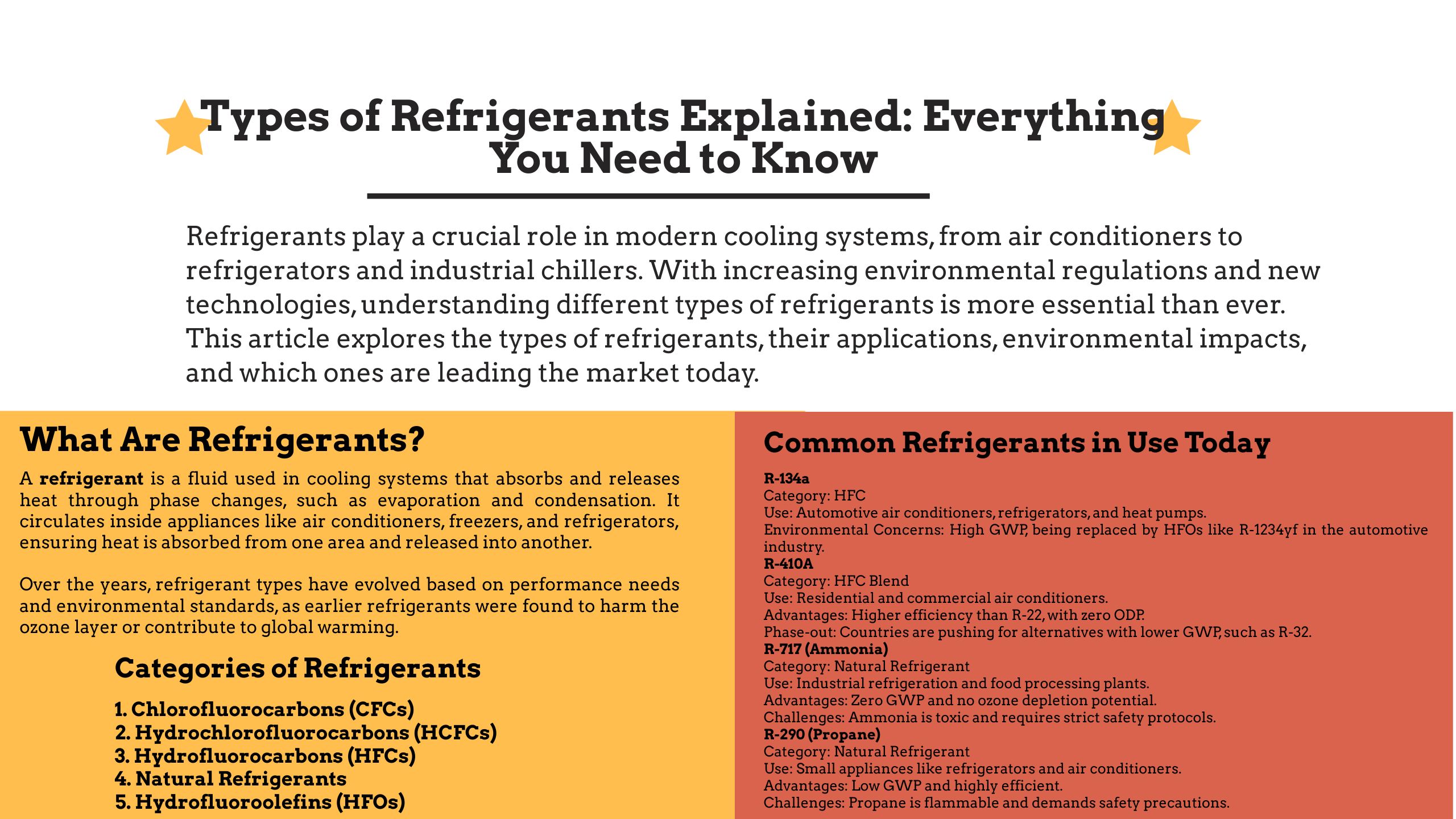
Refrigerants play a crucial role in modern cooling systems, from air conditioners to refrigerators and industrial chillers. With increasing environmental regulations and new technologies, understanding different types of refrigerants is more essential than ever. This article explores the types of refrigerants, their applications, environmental impacts, and which ones are leading the market today.
What Are Refrigerants?
A refrigerant is a fluid used in cooling systems that absorbs and releases heat through phase changes, such as evaporation and condensation. It circulates inside appliances like air conditioners, freezers, and refrigerators, ensuring heat is absorbed from one area and released into another.
Over the years, refrigerant types have evolved based on performance needs and environmental standards, as earlier refrigerants were found to harm the ozone layer or contribute to global warming.
More About Refrigerants: Understanding Refrigerants: Types, Uses, and Environmental Impact
How Refrigerants Work
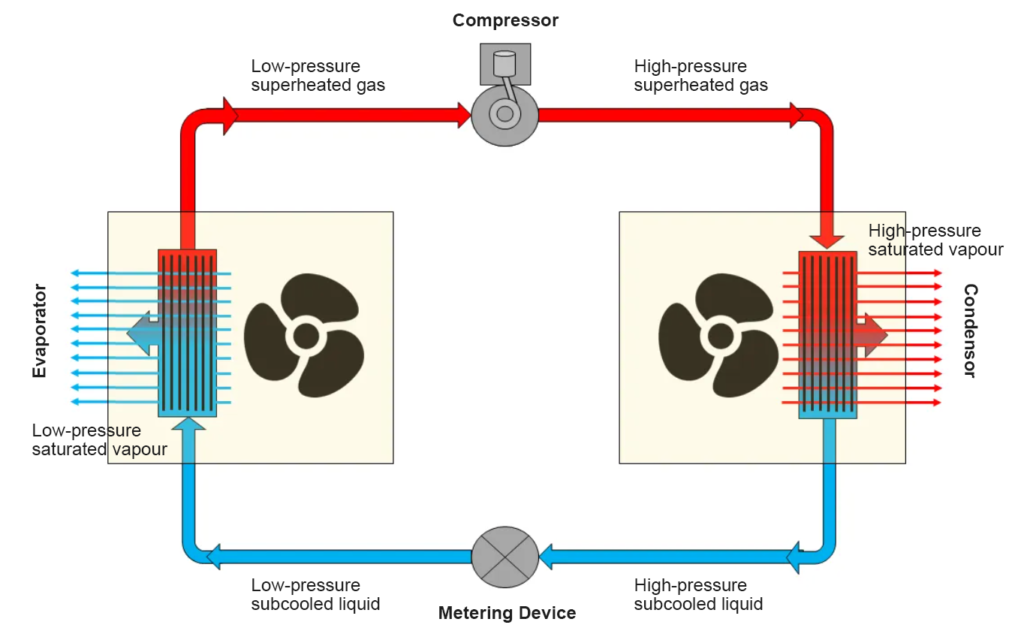
The refrigeration process relies on the vapor-compression cycle, which consists of four key steps:
- Compression: The refrigerant gas is compressed, raising its pressure and temperature.
- Condensation: The high-pressure gas flows through a condenser, where it releases heat and becomes a liquid.
- Expansion: The refrigerant passes through an expansion valve, reducing its pressure and temperature.
- Evaporation: The low-pressure liquid absorbs heat in the evaporator, turning back into gas and repeating the cycle.
This cycle is fundamental to the operation of air conditioners, refrigerators, and other cooling systems.
Categories of Refrigerants
Refrigerants can be classified into several groups based on their chemical composition and environmental impact:
1. Chlorofluorocarbons (CFCs)
- Examples: R-12, R-11
- Use: Older air conditioners, refrigerators, and industrial cooling systems.
- Characteristics: CFCs are highly stable and effective refrigerants but have an extremely high Ozone Depletion Potential (ODP).
- Environmental Impact: Due to their significant contribution to ozone depletion, CFCs have been phased out globally under the Montreal Protocol.
2. Hydrochlorofluorocarbons (HCFCs)
- Examples: R-22, R-123
- Use: Residential air conditioning and commercial refrigeration systems.
- Characteristics: HCFCs are less harmful to the ozone than CFCs, but they still have ODP and Global Warming Potential (GWP).
- Phase-out: R-22 has been gradually phased out in favor of more eco-friendly alternatives, such as R-410A.
3. Hydrofluorocarbons (HFCs)
- Examples: R-134a, R-410A, R-404A
- Use: Automotive air conditioners, home appliances, and commercial cooling.
- Characteristics: HFCs have zero ODP but contribute to global warming.
- Environmental Impact: With their high GWP, HFCs are being replaced by lower-GWP refrigerants under the Kigali Amendment to the Montreal Protocol.
4. Natural Refrigerants
- Examples: Ammonia (R-717), Carbon Dioxide (R-744), Propane (R-290)
- Use: Industrial cooling systems, supermarkets, and eco-friendly HVAC systems.
- Characteristics: Natural refrigerants have minimal environmental impact with low or zero GWP.
- Challenges: These refrigerants can be flammable or toxic, requiring specialized equipment and safety measures.
5. Hydrofluoroolefins (HFOs)
- Examples: R-1234yf, R-1234ze
- Use: Automotive air conditioning and commercial refrigeration.
- Characteristics: HFOs have low GWP and are considered a sustainable replacement for HFCs.
- Environmental Impact: While eco-friendlier than HFCs, HFOs are still under scrutiny due to their potential for chemical degradation into harmful substances.
Types of Refrigerants
Refrigerants are classified based on their chemical composition, environmental impact, and applications. Here is a breakdown of the most widely used refrigerants.
1. R-12 Refrigerant
- Category: Chlorofluorocarbon (CFC)
- Applications: Used in older refrigerators, automotive air conditioners, and commercial chillers.
- Phase-Out: Due to its high Ozone Depletion Potential (ODP), R-12 has been banned under the Montreal Protocol. Modern systems use R-134a or other substitutes.
2. R-22 Refrigerant
- Category: Hydrochlorofluorocarbon (HCFC)
- Applications: Previously used in home air conditioners and commercial refrigeration.
- Phase-Out: R-22 has been gradually replaced by R-410A and other environmentally friendly options because of its ODP and Global Warming Potential (GWP).
3. R-134a Refrigerant
- Category: Hydrofluorocarbon (HFC)
- Applications: Used in car air conditioners, refrigerators, and heat pumps.
- Environmental Impact: Although it has zero ODP, R-134a has a high GWP. It is being replaced by HFOs like R-1234yf in automotive applications.
4. R-290 Refrigerant (Propane)
- Category: Natural Refrigerant
- Applications: Suitable for small refrigerators, freezers, and air conditioners.
- Advantages: Extremely low GWP and excellent energy efficiency.
- Challenges: Propane is flammable, requiring careful handling and system designs that minimize risks.
5. R-404A Refrigerant
- Category: HFC Blend
- Applications: Used in commercial refrigeration, including supermarkets and food storage.
- Environmental Impact: High GWP, leading to the search for alternative refrigerants like R-448A or R-449A.
6. R-410A Refrigerant
- Category: HFC Blend
- Applications: Widely used in residential and commercial air conditioning.
- Advantages: Efficient and ozone-friendly, but with a high GWP.
- Future: Systems using R-410A are being replaced by alternatives like R-32 and R-454B to meet stricter environmental standards.
7. R-450A Refrigerant
- Category: HFO Blend
- Applications: Replacement for R-134a in commercial refrigeration.
- Advantages: Lower GWP compared to traditional HFCs, making it more eco-friendly.
8. R-454B Refrigerant
- Category: HFO Blend
- Applications: A next-generation refrigerant for air conditioners, offering lower GWP than R-410A.
- Advantages: Helps meet sustainability goals while maintaining system performance.
9. R-513A Refrigerant
- Category: HFO Blend
- Applications: An alternative to R-134a in commercial chillers and refrigerators.
- Advantages: Low GWP, non-flammable, and compatible with existing R-134a systems.
10. R-600a Refrigerant (Isobutane)
- Category: Natural Refrigerant
- Applications: Commonly used in household refrigerators and small freezers.
- Advantages: Low GWP and excellent energy efficiency.
- Challenges: Like propane, R-600a is flammable, requiring proper safety measures.
Common Refrigerants in Use Today
R-134a
- Category: HFC
- Use: Automotive air conditioners, refrigerators, and heat pumps.
- Environmental Concerns: High GWP, being replaced by HFOs like R-1234yf in the automotive industry.
R-410A
- Category: HFC Blend
- Use: Residential and commercial air conditioners.
- Advantages: Higher efficiency than R-22, with zero ODP.
- Phase-out: Countries are pushing for alternatives with lower GWP, such as R-32.
R-717 (Ammonia)
- Category: Natural Refrigerant
- Use: Industrial refrigeration and food processing plants.
- Advantages: Zero GWP and no ozone depletion potential.
- Challenges: Ammonia is toxic and requires strict safety protocols.
R-290 (Propane)
- Category: Natural Refrigerant
- Use: Small appliances like refrigerators and air conditioners.
- Advantages: Low GWP and highly efficient.
- Challenges: Propane is flammable and demands safety precautions.
How to Choose the Right Refrigerant
Choosing the appropriate refrigerant depends on several factors, including system efficiency, environmental regulations, and safety requirements. Here are key considerations:
- Environmental Regulations
- Ensure the refrigerant complies with regional laws and global agreements, such as the Montreal Protocol and Kigali Amendment.
- HFOs and natural refrigerants are often recommended for meeting sustainability goals.
- System Compatibility
- Some refrigerants require new equipment or retrofitting existing systems. For instance, switching from R-22 to R-410A involves significant equipment upgrades.
- Safety Concerns
- Natural refrigerants like ammonia and propane are eco-friendly but require robust safety measures due to toxicity or flammability.
- Cost Efficiency
- Consider the total lifecycle cost, including installation, maintenance, and energy consumption.
- HFOs may have a higher upfront cost but offer long-term benefits in terms of reduced environmental impact.
Related Read: Comparative Analysis of Refrigerants, Properties, Advantages, and Disadvantages
Environmental Impact of Refrigerants
The shift towards greener refrigerants is driven by two main concerns:
1. Ozone Depletion Potential (ODP)
- Refrigerants like CFCs and HCFCs deplete the ozone layer, contributing to the increase in UV radiation reaching Earth.
2. Global Warming Potential (GWP)
- Even non-ozone-depleting refrigerants, such as HFCs, contribute to climate change due to their high GWP. Regulations now encourage the adoption of low-GWP alternatives.
Future Trends in Refrigerants
The refrigerant industry is rapidly evolving, with a clear trend towards eco-friendlier solutions.
1. Wider Adoption of HFOs
HFOs like R-1234yf are gaining traction in automotive and commercial applications due to their low environmental impact.
2. Natural Refrigerants as Mainstream Options
Ammonia, propane, and CO₂ are being increasingly used in industrial settings and supermarkets.
3. Global Phase-Outs and New Regulations
Countries are setting deadlines for phasing out high-GWP refrigerants, accelerating the shift towards sustainable alternatives.
4. Technological Innovations
Researchers are exploring blended refrigerants that combine the best properties of various gases while minimizing environmental harm.
FAQ
Refrigerant-Related Acronyms
Here are some key acronyms you’ll encounter when discussing refrigerants:
- ODP (Ozone Depletion Potential): Measures a refrigerant’s impact on the ozone layer.
- GWP (Global Warming Potential): Indicates a refrigerant’s contribution to climate change relative to CO₂.
- HFC (Hydrofluorocarbon): A type of refrigerant with zero ODP but high GWP.
- HCFC (Hydrochlorofluorocarbon): Older refrigerants with moderate ODP, now phased out.
- HFO (Hydrofluoroolefin): New-generation refrigerants with low GWP and zero ODP.
- CFC (Chlorofluorocarbon): Ozone-depleting refrigerants phased out under the Montreal Protocol.
Services Related to Refrigerants
- System Installation: Professional installation ensures refrigerant systems operate efficiently and meet safety standards.
- Maintenance and Repair: Regular maintenance is essential for preventing refrigerant leaks and ensuring peak performance.
- Refrigerant Retrofit: Some systems require retrofitting to use eco-friendly refrigerants, such as upgrading from R-22 to R-410A.
- Leak Detection and Recovery: Technicians use specialized tools to detect and recover leaked refrigerants, minimizing environmental harm.
- Compliance Consulting: Businesses must adhere to local and international regulations regarding refrigerant use.
Conclusion
Refrigerants are essential to our everyday lives, keeping homes cool, preserving food, and powering industries. However, the environmental impact of traditional refrigerants has led to a transformation in the industry. New regulations encourage the use of natural refrigerants and low-GWP options like HFOs to reduce global warming. As technology advances, the refrigerant market will continue evolving, making it vital to stay informed and compliant with environmental standards.
Choosing the right refrigerant involves balancing performance, safety, and environmental responsibility. By understanding the types of refrigerants available today and their future prospects, businesses and consumers can make better-informed decisions for sustainable cooling solutions.
References
- EPA (Environmental Protection Agency): Guidelines on refrigerant phase-outs and environmental standards.
- ASHRAE (American Society of Heating, Refrigerating, and Air-Conditioning Engineers): Industry standards for refrigerants and cooling systems.
- Kigali Amendment: Global treaty to phase down high-GWP refrigerants.
- Montreal Protocol: Agreement to eliminate ozone-depleting substances, including certain refrigerants.
Looking for reliable refrigerant suppliers from China ?
We offer end-to-end procurement solutions, handling everything from sourcing to shipping, ensuring you get the best products at competitive prices.
- [email protected]
- +86 18037022596
- 18037022596